I still remember the moment I got confused about this. I was writing a food post and typed, “You should savour every bite.” It sounded nice. A bit classy, honestly. But then I paused. Something didn’t feel right. Most of my readers were from the US, and I had seen “savor” used way more often. So I sat there staring at the word, thinking… should I keep savour or change it to savor?
I didn’t want my writing to look strange or out of place. So I quickly searched it. And that’s when it clicked. Both words mean the same thing but the spelling depends on where your audience is from. That small moment actually taught me something important. It’s not always about right or wrong. Sometimes, it’s about choosing what feels natural for your reader.
If you’ve ever been stuck between savor or savour, trust me, you’re not alone. I’ve been exactly where you are. The good news? Once I learned this simple difference, I never had to think twice again.
Let me show you how I handled it so you can fix it instantly too.
✅ Savor or Savour – Quick Answer
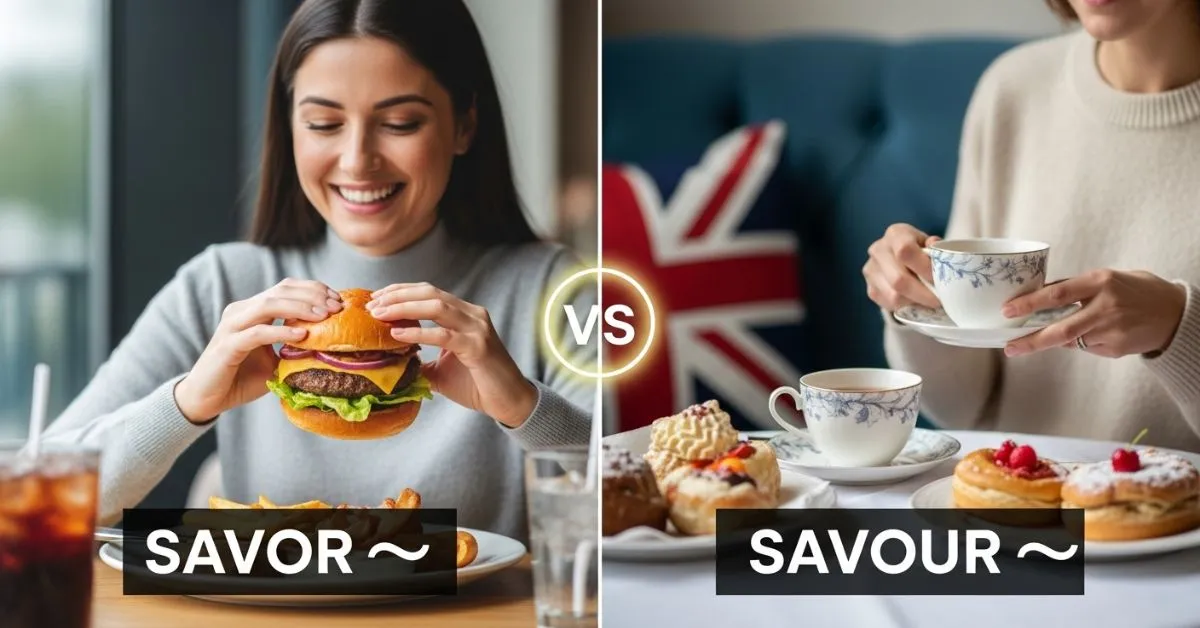
Savor = American English spelling
Savour = British English spelling
✔️ Examples:
- I savor every moment of success. 🇺🇸
- She savours her morning coffee. 🇬🇧
👉 Quick rule:
Use savor for US audiences. Use savour for UK style.
📖 What Does Savor or Savour Mean?
Both words have the same meaning.
They mean:
- To enjoy something fully
- To take time and appreciate a taste, moment, or feeling
Savor (American English)
Used in the United States.
👉 Think: enjoy deeply
✔️ Examples:
- I savor every bite of pizza.
- She savors her free time.
- He savored the moment.
Savour (British English)
Used in the UK and some other regions.
👉 Same meaning, different spelling
✔️ Examples:
- She savours her tea.
- They savoured the experience.
👉 Key idea:
Meaning stays the same. Only spelling changes.
🧠 Why Do People Confuse Savor or Savour?
This confusion happens for simple reasons:
1. Same meaning
Both words mean exactly the same thing.
2. Spelling variation
The only difference is the extra “u” in British English.
3. Internet mix
Online content shows both versions, which confuses readers.
4. Global audience
Writers are unsure which version fits their audience.
👉 Key takeaway:
This is not a meaning problem it’s a spelling choice.
⚖️ Savor vs Savour
| Feature | Savor 🇺🇸 | Savour 🇬🇧 |
| Spelling | Savor | Savour |
| Meaning | Same | Same |
| Usage | US English | UK English |
| Popularity | Very high | Moderate |
| Tone | Modern (US) | British style |
👉 Simple explanation:
Savor = American
Savour = British
American vs British Usage
Here’s where the real difference shows:
| Region | Preferred Word |
| 🇺🇸 United States | Savor |
| 🇬🇧 United Kingdom | Savour |
| 🌍 Global | Savor (more common) |
👉 Key insight:
- Americans use savor almost always
- British writers use savour
- Globally, savor is more popular
👉 Simple rule:
If your audience is US → always use savor
💬 Real-Life Examples of Savor or Savour
Let’s see how these words appear in daily life.
📧 Emails
- Please take time to savor this experience.
- We hope you savour every moment (UK style).
📱 Social Media
- Savor the little things in life ❤️
- Savour every sip ☕ (UK style)
🏢 Workplace
- Take a moment to savor your success.
- She savoured the achievement.
🗣️ Daily Conversation
- “I like to savor my weekends.”
- “He savoured the moment.”
👉 Notice:
Most global content prefers savor
⚠️ Common Mistakes to Avoid
Here are mistakes people often make:
- ❌ Wrong: Using savour for US audience
✅ Correct: Use savor - ❌ Wrong: Mixing both in one article
✅ Correct: Stick to one style - ❌ Wrong: Thinking meanings are different
✅ Correct: Meanings are the same - ❌ Wrong: Using British spelling in US business writing
✅ Correct: Use American spelling - ❌ Wrong: Ignoring audience
✅ Correct: Always match your readers
👉 Tip:
Consistency matters more than preference.
🎯 Pro Tips to Remember Savor or Savour
✔️ US = no “u” → savor
✔️ UK = add “u” → savour
✔️ If writing globally → use savor
✔️ Blogs and SEO → prefer savor
✔️ Always think: who is reading?
👉 Memory hack:
America drops the “u” → savor
📊 Usage Trends & Popularity
📈 Trends show:
- Savor → extremely high usage
- Savour → lower usage
🌎 Common in:
- USA → Savor
- UK → Savour
- Global → Savor dominates
👉 Why is “savor” more popular?
Because most online content is US-based.
👉 Insight:
If you want better readability and reach → use savor.
FAQs ❓
1. What is the difference between savor and savour?
There is no difference in meaning. Only spelling changes based on region.
2. Is savour wrong?
No, it is correct in British English.
3. Which spelling should I use in the US?
Always use savor in American writing.
4. Which spelling is more common globally?
Savor is more common worldwide.
5. Do they have different meanings?
No. Both mean to enjoy something fully.
6. Can I use savour in blogs?
Yes, but only if your audience is British.
7. Why does British English add “u”?
It’s part of traditional British spelling patterns.
8. Which is better for SEO?
Savor works better for global and US traffic.
9. How can I remember the difference?
Think: US = no “u”, UK = add “u”.
🧾 Conclusion
The confusion between savor or savour is very common, but the answer is simple once you understand the pattern.
Both words mean exactly the same thing. They describe enjoying something deeply whether it’s food, a moment, or a feeling.
The only real difference is spelling.
In American English, the correct form is savor. It’s modern, simple, and widely used across the internet, especially in blogs, business writing, and daily communication.
In British English, the spelling becomes savour. It’s not wrong it’s just regional.
If your goal is to write clearly for a US or global audience, savor is the best choice. It keeps your writing natural and easy to understand.
👉 Final takeaway:
Use savor for US and global readers. Use savour only for British style.
Once you remember this, you’ll never get confused again.
Discover More Articles:
- Formerly or Formally : Quick Guide for Clear Writing✍️(2026)
- Dawn or Dusk : Quick & Easy Guide🌅(2026)
- Heals or Heels : The Quick Grammar Guide Everyone Needs👠(2026)

“I’m Noah Webster, a grammar expert at Grammeriffy.com. I provide clear tips to help readers master English writing confidently.”