I still remember the moment I messed this up. I was telling a story to a friend and said, “Yesterday, I drunk too much coffee.” I said it confidently… like it was 100% correct. But then my friend paused and said, “You mean you drank too much coffee.” That one small correction hit me harder than I expected.
I had heard both drunk and drank so many times. They sounded right. They felt natural. And honestly, I never stopped to think if I was using them correctly. So later that day, I looked it up. And that’s when I realized something simple but important. These two words are not interchangeable. They follow a clear grammar rule. And once you understand it, everything becomes easy.
If you’ve ever searched for drunk or drank, you’re probably dealing with the same confusion. It shows up in daily conversations, emails, storytelling, and even professional writing. The good news? This is one of the easiest grammar fixes you’ll ever learn. Once you get this one rule, you’ll never hesitate again.
Let’s break it down.
✅ Drunk or Drank – Quick Answer
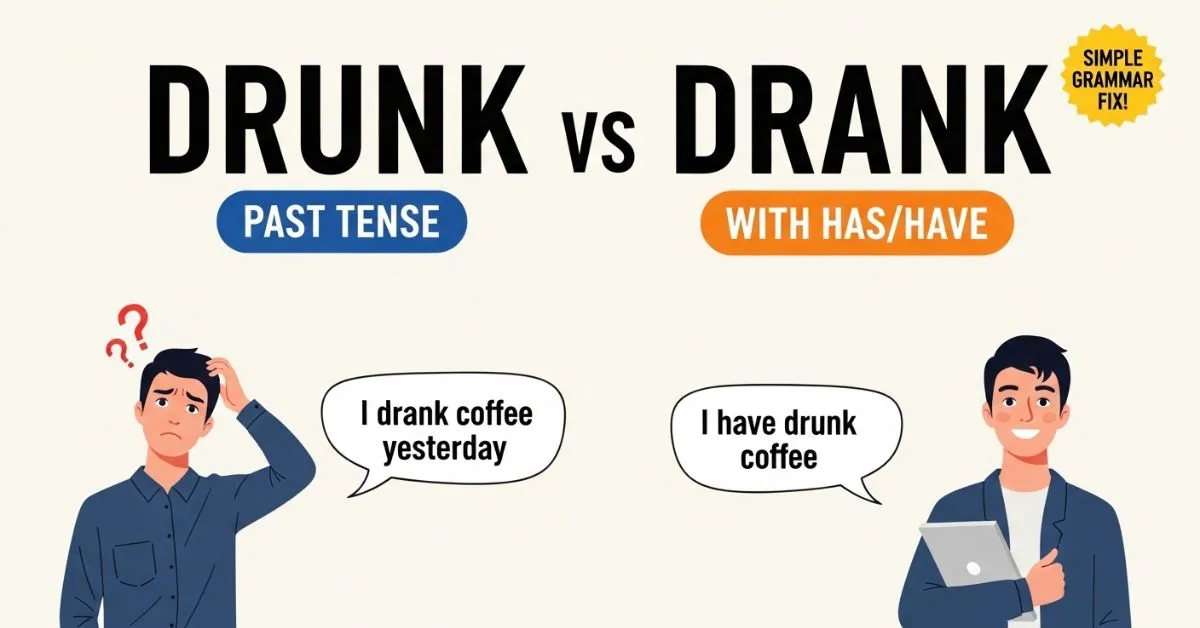
Drank = past tense of “drink”
Drunk = past participle (used with has/have/had)
✔️ Examples:
- I drank water yesterday.
- I have drunk three cups of coffee.
- She has drunk all the juice.
👉 Quick rule:
Drank = past action | Drunk = used with has/have/had
📖 What Does Drunk or Drank Mean?
Both words come from the verb “drink.”
They both talk about consuming a liquid.
Drank
“Drank” is the simple past tense.
👉 Think: something already happened
✔️ Examples:
- I drank tea this morning.
- He drank all the milk.
- They drank juice after lunch.
👉 Key idea:
Used for past actions without helping verbs
Drunk
“Drunk” is the past participle.
👉 Think: used with helping verbs (has, have, had)
✔️ Examples:
- I have drunk enough water.
- She has drunk the entire bottle.
- They had drunk coffee before the meeting.
👉 Key idea:
Used with has/have/had
🧠 Why Do People Confuse Drunk or Drank?
This confusion happens for simple reasons:
- Same base verb
Both come from “drink.” - Similar sound
They sound very close in conversation. - Grammar rules confusion
Many people don’t fully understand past vs past participle. - Casual speech habits
People often say “I drunk” in informal speech.
👉 Key takeaway:
This is a grammar structure problem, not a meaning problem.
⚖️ Drunk vs Drank
| Feature | Drank ✅ | Drunk ⭐ |
| Type | Past tense | Past participle |
| Meaning | Action in the past | Completed action |
| Usage | Simple sentences | With has/have/had |
| Example | I drank water | I have drunk water |
| Grammar role | Main verb | With helper verb |
👉 Simple explanation:
Drank = past action
Drunk = used with helping verbs
American vs British Usage
Good news no major difference here.
| Region | Drank | Drunk |
| 🇺🇸 USA | Common | Common |
| 🇬🇧 UK | Common | Common |
| 🌍 Global | Common | Common |
👉 Insight:
Both follow the same grammar rules worldwide
💬 Real Life Examples of Drunk or Drank
📧 Emails
- I drank the coffee before the meeting.
- I have drunk too much caffeine today.
📱 Social Media
- I drank way too much soda 😅
- I’ve drunk three smoothies today 🥤
🏢 Workplace
- He drank water during the break.
- She has drunk all the juice in the fridge.
🗣️ Daily Conversation
- “I drank coffee this morning.”
- “I’ve drunk enough for today.”
👉 Notice:
In casual speech, people may say “I drunk,” but it’s not correct grammar.
⚠️ Common Mistakes to Avoid
- ❌ Wrong: I drunk water yesterday
✅ Correct: I drank water yesterday - ❌ Wrong: She has drank coffee
✅ Correct: She has drunk coffee - ❌ Wrong: They drunk all the juice
✅ Correct: They drank all the juice - ❌ Wrong: Mixing both randomly
✅ Correct: Follow grammar rules - ❌ Wrong: Ignoring helping verbs
✅ Correct: Use “drunk” with has/have/had
👉 Tip:
If you see has/have/had → use drunk
🎯 Pro Tips to Remember Drunk or Drank
✔️ Drank = Past (both start with “D”)
✔️ Drunk = Used with has/have
✔️ If no helper verb → use drank
✔️ If helper verb is present → use drunk
✔️ Practice simple sentences
👉 Memory hack:
Has = Drunk | Past = Drank
📊 Usage Trends & Popularity
📈 Trends show:
- Drank → very common in daily speech
- Drunk → common in formal and correct grammar use
🌎 Common in:
- USA
- UK
- Global English
👉 Insight:
“Drunk” appears more in correct written grammar, while “drank” dominates simple past usage.
FAQs❓
1. What is the difference between drunk and drank?
Drank is past tense. Drunk is past participle used with has, have, or had.
2. Is “I drunk water” correct?
No. The correct sentence is “I drank water.”
3. Is “I have drank” correct?
No. It should be “I have drunk.”
4. Which word is more common?
Both are common but used in different grammar forms.
5. Can drunk mean intoxicated?
Yes, “drunk” can also mean affected by alcohol.
6. When should I use drank?
Use it for past actions without helping verbs.
7. When should I use drunk?
Use it with has, have, or had.
8. Is there a US vs UK difference?
No, both follow the same rule worldwide.
9. What’s the easiest way to remember?
Think: Past = drank, Has/Have = drunk.
🧾 Conclusion
The confusion between drunk or drank is very common, but the solution is simple once you understand the rule.
Both words come from the same verb, “drink,” and both relate to consuming liquids. But the difference lies in how they are used in a sentence.
Drank is the simple past tense. It describes something that already happened.
Example: “I drank water yesterday.”
Drunk is the past participle. It works with helping verbs like “has,” “have,” and “had.”
Example: “I have drunk enough water.”
In everyday speech, many people mix these up. You might hear “I drunk water,” but it’s not grammatically correct. Using the right form makes your writing and speaking clearer and more professional.
The best part? This is an easy fix.
Just pause and ask yourself one simple question:
👉 Is there a helping verb (has/have/had)?
If yes → use drunk
If no → use drank
👉 Final takeaway:
Use drank for past actions.
Use drunk with has/have/had.
Once you lock this in, you’ll never get confused again.
Discover More Articles:
- Jinks or Jinx : Learn the Correct Spelling Fast🧿(2026)
- Sheer or Shear : Meaning, Examples & Easy Rule✨(2026)
- Sank or Sunk : Learn the Correct Usage in Seconds🚢(2026)

“I’m David Crystal, a grammar expert at Grammeriffy.com. I help readers master English with clear, practical writing tips.”