I still remember the moment I got stuck on a simple sentence while writing something important. I typed: “These ones are better.” Then I paused. Something felt off, but I couldn’t figure out what. Was it correct or wrong?
So I did what most people do… I second-guessed myself and started Googling. That’s when I first came across the confusion between “ones” and “one’s.” And honestly, I felt a bit embarrassed because it looked like such a small thing, but I couldn’t confidently explain the difference.
I remember thinking, “How can two tiny words with almost the same spelling cause so much confusion?” Later, I realized I wasn’t the only one facing this issue. A lot of people mix them up because they sound similar, and in fast writing, the apostrophe just gets ignored.
What really helped me was understanding one simple idea: it’s not about spelling it’s about meaning. Once I figured that out, everything became clear. I stopped guessing and started using both words correctly without overthinking.
And if you’re here because you also get confused between ones or one’s, trust me you’re not alone. I’ve been in that exact situation, and I know how frustrating it feels when something so small keeps slowing your writing down.
Let’s break it down in a super simple way so you never get stuck on it again 👇
✅ Ones or One’s – Quick Answer
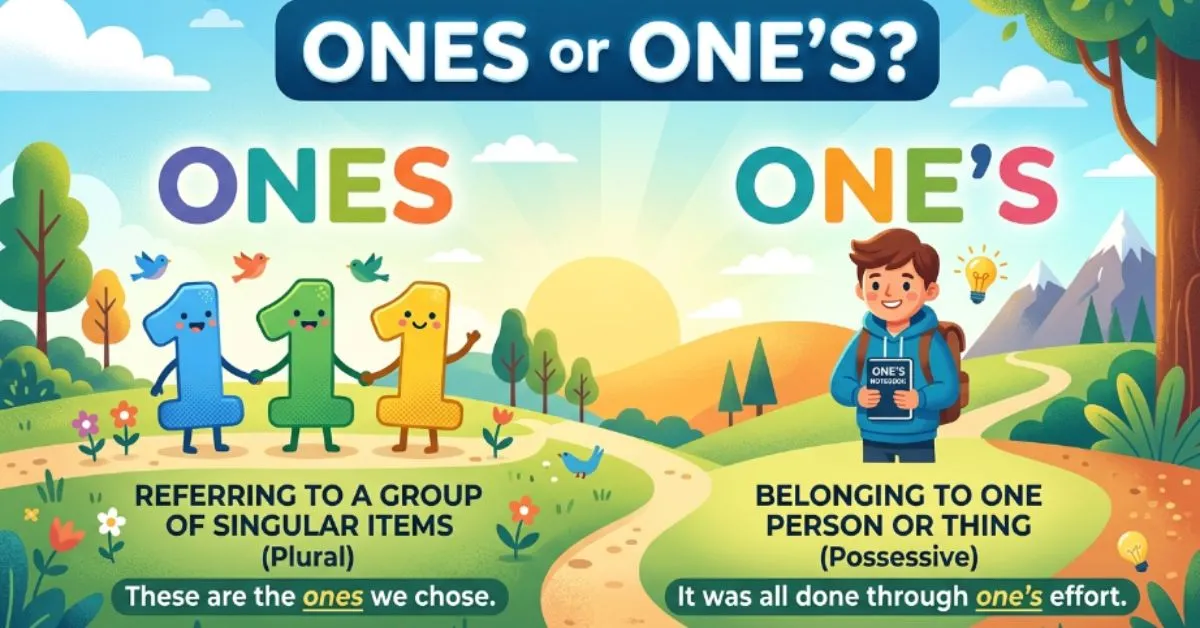
Ones = plural of “one” (means many)
One’s = possessive form (means something belongs to one person)
✔️ Examples:
- I like the red ones.
- One should take care of one’s health.
- These ones are better.
👉 Quick rule:
Ones = many | One’s = belongs to one
📖 What Does Ones or One’s Mean?
Let’s keep it simple.
Ones
“Ones” is the plural form of “one.”
👉 Think: more than one
✔️ Examples:
- I prefer the blue ones.
- These shoes are better than the old ones.
- Pick the small ones.
👉 Key idea:
“Ones” talks about multiple things.
One’s
“One’s” shows possession.
👉 Think: something belongs to someone
✔️ Examples:
- One should respect one’s elders.
- It’s important to know one’s limits.
- Everyone must take care of one’s health.
👉 Key idea:
The apostrophe ( ’s ) shows ownership.
🧠 Why Do People Confuse Ones or One’s?
This confusion happens for simple reasons:
1. Apostrophe confusion
Many people don’t know when to use ’s.
2. Similar spelling
The only difference is one small apostrophe.
3. Fast writing
People skip grammar checks in quick messages.
4. Lack of clarity
Plural vs possessive rules can feel tricky.
👉 Key takeaway:
This is a grammar rule issue, not a vocabulary problem.
⚖️ Ones vs One’s
| Feature | Ones ✅ | One’s ⭐ |
| Type | Plural | Possessive |
| Meaning | More than one | Belonging to one |
| Usage | Objects, items | Ownership |
| Example | These ones are nice | One’s goal matters |
| Apostrophe | No | Yes |
👉 Simple explanation:
- Ones = many things
- One’s = something belongs to one
American vs British Usage
Good news there is no difference here.
| Region | Ones | One’s |
| 🇺🇸 USA | Same usage | Same usage |
| 🇬🇧 UK | Same usage | Same usage |
| 🌍 Global | Same | Same |
👉 Insight:
This is a universal grammar rule. No regional confusion.
💬 Real Life Examples of Ones or One’s
📧 Emails
- Please choose the correct ones.
- One must understand one’s responsibilities.
📱 Social Media
- I like these ones better 😍
- Always protect one’s peace ✨
🏢 Workplace
- Use the updated ones.
- One should improve one’s skills regularly.
🗣️ Daily Conversation
- “I’ll take the black ones.”
- “One should know one’s limits.”
👉 Notice:
Context tells you which one to use.
⚠️ Common Mistakes to Avoid
- ❌ Wrong: I like this ones
✅ Correct: I like these ones - ❌ Wrong: Everyone should take care of ones health
✅ Correct: Everyone should take care of one’s health - ❌ Wrong: These one’s are good
✅ Correct: These ones are good - ❌ Wrong: Mixing both randomly
✅ Correct: Use based on meaning - ❌ Wrong: Ignoring apostrophe rules
✅ Correct: Use ’s for possession only
👉 Tip:
If you can replace it with “his/her” → use one’s
🎯 Pro Tips to Remember Ones or One’s
✔️ Ones = plural (no apostrophe)
✔️ One’s = possession (has ’s)
✔️ Apostrophe = ownership
✔️ If it shows belonging → use one’s
✔️ If it shows quantity → use ones
👉 Memory hack:
’s = owns → one’s
📊 Usage Trends & Popularity
📈 Trends show:
- Both ones and one’s are commonly used
- Usage depends on sentence type
🌎 Common in:
- USA
- UK
- Global English
👉 Insight:
Both are important, but used in different situations.
FAQs ❓
1. What is the difference between ones and one’s?
Ones is plural. One’s shows possession. The apostrophe makes the difference.
2. Is “ones” correct?
Yes, it is correct when talking about multiple things.
3. Is “one’s” correct?
Yes, it is correct when showing ownership or possession.
4. When should I use one’s?
Use it when something belongs to one person.
5. When should I use ones?
Use it when referring to multiple items or things.
6. Is there a difference in US and UK usage?
No, both follow the same rule worldwide.
7. Why is this confusing?
Because of the small apostrophe and similar spelling.
8. Can I ignore the apostrophe?
No, it changes the meaning of your sentence.
9. What is an easy trick to remember?
Think: ’s = owns → one’s shows ownership.
Conclusion
The confusion between ones or one’s may seem small, but it can make a big difference in your writing.
Both words look almost the same, but their meanings are completely different. One talks about quantity. The other shows possession. That tiny apostrophe changes everything.
Ones is used when you are talking about more than one thing. It’s simple and direct.
One’s is used when something belongs to someone. The apostrophe shows ownership.
The best part? This is an easy rule to remember once you understand it.
In everyday writing emails, messages, blogs, or work you’ll use both forms. The key is to stop for a second and ask:
👉 Am I talking about many things? Or something that belongs to someone?
That one question will guide you every time.
👉 Final takeaway:
Use ones for many. Use one’s for ownership.
Once you lock this in, you’ll never get confused again.
Discover More Articles:
- Practice or Practise : Quick Answer for Writers✍️(2026)
- Transfered or Transferred : Easy Guide with Examples📖(2026)
- Tought or Taught : Learn the Correct Spelling Fast📖(2026)

“I’m Agatha Christie, the grammar expert behind Grammeriffy.com. I help readers master English with clear, reliable writing tips.”