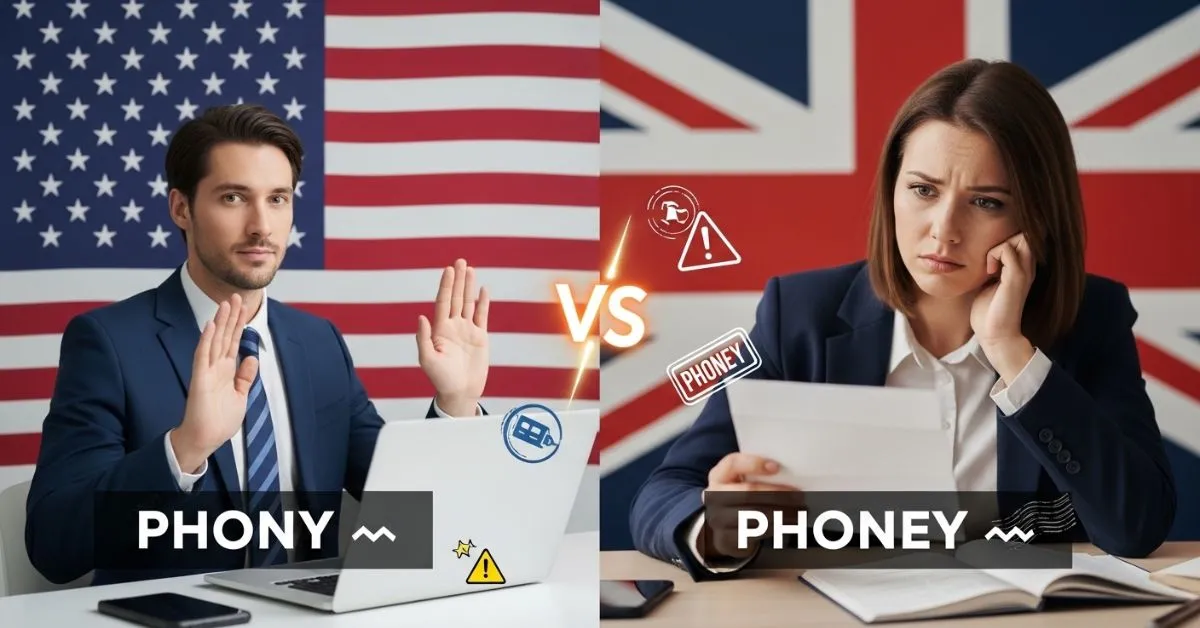
I still remember the moment I got stuck on this. I was writing a quick message and typed, “This deal sounds a bit phoney.” Me paused for a second. Something didn’t feel right. I had seen phony before too, and suddenly I wasn’t sure which one was correct.
I didn’t want to look careless, especially because it was a professional message. So I stopped, opened a new tab, and searched it. That’s when I realized something simple but important. Both phoney and phony mean the same thing but they are not used the same way everywhere.
I felt a bit relieved… and a little annoyed too. It was such a small difference, but it could make my writing look off, especially for a US audience.
If you’re reading this, you’re probably in the same situation. You know the meaning. You just don’t know which spelling to trust.
I’ve been there. And once I figured it out, it became one of the easiest fixes in English.
Let me show you exactly how I handled it so you never have to second guess this again.
✅ Phoney or Phony – Quick Answer
- Phony = fake or not real (preferred in American English)
- Phoney = same meaning, but used in British English
✔️ Examples:
- That offer sounds phony.
- He gave a phony excuse.
- The story felt phoney (UK style).
👉 Quick rule:
Use “phony” for US writing.
📖 What Does Phoney or Phony Mean?
Both words mean the same thing: something that is not real.
Phony
Phony means fake, not genuine, or dishonest.
👉 Think: not real
✔️ Examples:
- That website looks phony.
- He made a phony promise.
- She used a phony name.
Phoney
Phoney also means fake or false.
👉 Think: same meaning, different spelling
✔️ Examples:
- His smile seemed phoney.
- That excuse sounds phoney.
👉 Key idea:
The meaning is the same. Only the spelling changes.
🧠 Why Do People Confuse Phoney or Phony?
Here’s why this confusion happens:
1. Same pronunciation
Both words sound exactly the same.
2. Similar spelling
Only one extra letter makes the difference.
3. Regional variation
US prefers one spelling, UK uses another.
4. Internet mix
Online content shows both versions.
👉 Key takeaway:
This confusion is about spelling style, not meaning.
⚖️ Phoney vs Phony
| Feature | Phony ✅ | Phoney ⚠️ |
| Spelling | Phony | Phoney |
| Meaning | Fake, not real | Same meaning |
| Usage | Very common (US) | Less common (UK) |
| Region | USA | UK |
👉 Simple explanation:
Both are correct, but phony is the better choice for most users.
American vs British Usage
Here’s the key difference:
| Region | Preferred Spelling |
| 🇺🇸 USA | phony |
| 🇬🇧 UK | phoney |
| 🌍 Global | phony |
👉 Insight:
Phony is more widely used worldwide.
💬 Real Life Examples of Phoney or Phony
📧 Emails
That claim sounds phony.
The offer looks phoney (UK style).
📱 Social Media
This deal feels phony 😅
That influencer seems phoney.
🏢 Workplace
The report contains phony data.
That explanation sounds phony.
🗣️ Daily Conversation
“That sounds phony.”
“He gave a phony excuse.”
👉 Notice:
You’ll see phony much more often.
⚠️ Common Mistakes to Avoid
- ❌ Wrong: Using phoney in US business writing
✅ Correct: Use phony - ❌ Wrong: Thinking meanings are different
✅ Correct: Both mean the same - ❌ Wrong: Mixing both spellings
✅ Correct: Stay consistent - ❌ Wrong: Guessing based on sound
✅ Correct: Follow region - ❌ Wrong: Overusing rare forms
✅ Correct: Use the common version
👉 Tip:
For safe writing → use phony
🎯 Pro Tips to Remember Phoney or Phony
- ✔️ Phony = Popular in the US 🇺🇸
- ✔️ “Phoney” looks longer → think British style
- ✔️ If writing online → choose phony
- ✔️ Keep your audience in mind
- ✔️ When in doubt → use phony
👉 Memory hack:
Phony = Primary choice
📊 Usage Trends & Popularity
📈 Trends show:
- Phony → very high usage
- Phoney → lower usage
🌎 Common in:
- USA
- Global English
👉 Why is “phony” more popular?
Because it is simpler and widely accepted.
👉 Insight:
Most modern writing uses phony.
FAQs ❓
1. What is the difference between phoney and phony?
There is no difference in meaning. Only the spelling differs. Phony is used in the US, while phoney is used in the UK.
2. Is phoney incorrect?
No, it is not incorrect. It is just less common, especially in American English.
3. Which spelling should I use?
Use phony for most situations, especially for US audiences.
4. Is phony informal?
It can be informal, but it is widely used in everyday writing.
5. Why do both spellings exist?
English has regional spelling differences between US and UK.
6. Which one is more common?
Phony is more common globally.
7. Can I use phoney in blogs?
You can, but phony is better for global readability.
8. Is phony used in business writing?
Yes, but carefully. It can sound casual depending on context.
9. How can I remember the difference?
Think: US = phony, UK = phoney.
🧾 Conclusion
The confusion between phoney or phony is very common, but the answer is simple.
Both words mean the same thing. They both describe something fake or not real. So technically, both are correct.
But when it comes to real-world usage, one clearly stands out.
In modern English especially in the United States and global content phony is the preferred choice. It is simpler, more common, and feels natural in everyday writing.
On the other hand, phoney is mostly used in British English. It’s not wrong, but it can sound unusual to a US audience.
If you want your writing to feel clear, modern, and professional, it’s best to stick with phony.
The good news? This is an easy fix.
👉 Final takeaway:
Use “phony” for almost everything. Use “phoney” only for British style.
Once you remember this, you’ll never get confused again.
Discover More Articles:
- Phase or Faze : Clear Meaning, Examples & Easy Rule🔄(2026)
- Plead or Pay : Easy Explanation with Real Life Examples⚖️(2026)
- Weary or Wary : Learn the Difference Fast😴(2026)

“I’m George Orwell, a grammar expert at Grammeriffy.com. I help readers improve their English with clear and reliable writing guidance.”