I still remember the day I mixed up prokaryotic and eukaryotic cells during a biology quiz. I felt confident. The question seemed easy. But when the results came back, I realized I had confused a bacterial cell with an animal cell.
It was embarrassing because I thought I understood the topic.
If you’ve ever searched for “prokaryotic or eukaryotic”, you’re not alone. Thousands of students, teachers, and science enthusiasts look up this term because cell classification can be confusing. Many organisms share similar features, making it hard to know whether they are prokaryotic or eukaryotic.
The confusion usually starts when people learn about bacteria, plants, animals, fungi, and protists. Some have simple cells. Others have complex cells. Remembering which group belongs where can feel overwhelming.
The good news is that the difference is actually very simple once you understand one key idea: the presence or absence of a nucleus.
In this guide, you’ll learn exactly what prokaryotic or eukaryotic means, why people often confuse them, how to identify them quickly, and practical tricks that make remembering the difference much easier.
Keep reading because one simple rule can help you identify almost any organism in seconds.
✅ Prokaryotic or Eukaryotic – Quick Answer
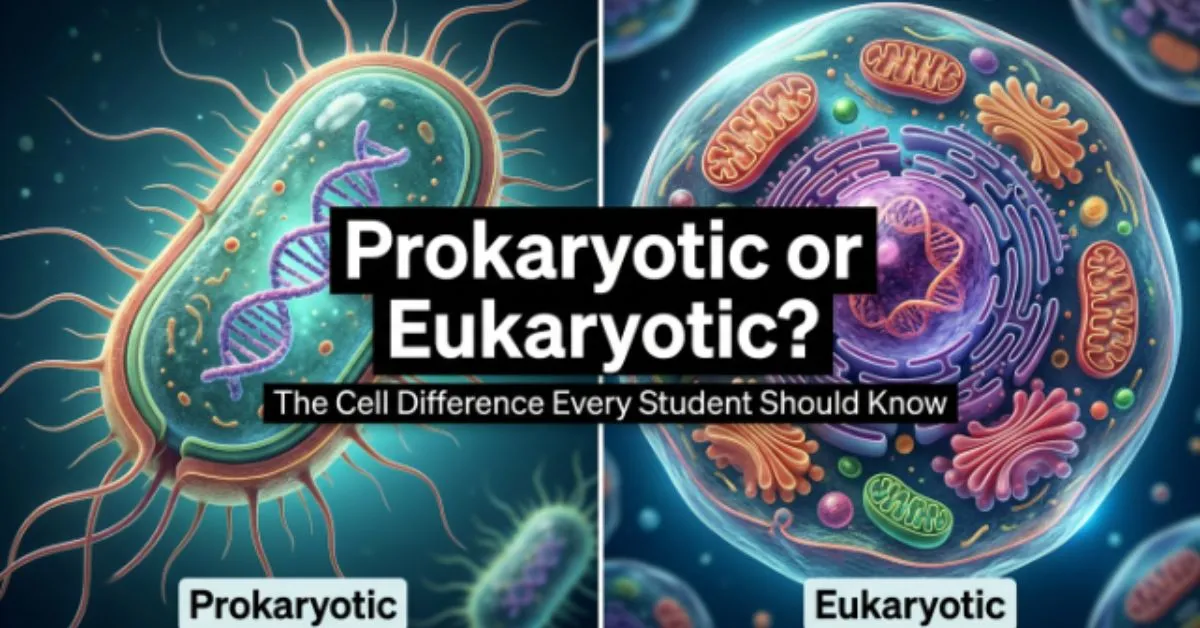
Prokaryotic cells do not have a nucleus or membrane-bound organelles.
Eukaryotic cells have a nucleus and specialized organelles.
Examples:
- Bacteria = Prokaryotic
- Human cells = Eukaryotic
- Plant cells = Eukaryotic
A quick rule: If the cell has a nucleus, it is eukaryotic. If it lacks a nucleus, it is prokaryotic.
📖 What Does Prokaryotic or Eukaryotic Mean?
The terms describe two major types of cells found in living organisms.
Prokaryotic Cells
Prokaryotic cells are simple and small. They do not contain a true nucleus. Their genetic material floats freely inside the cell.
Examples include:
- Bacteria
- Archaea
These organisms are usually single-celled and reproduce quickly.
Eukaryotic Cells
Eukaryotic cells are larger and more complex. They contain a nucleus that protects genetic material.
Examples include:
- Humans
- Dogs
- Trees
- Mushrooms
Eukaryotic cells also contain organelles such as mitochondria, chloroplasts, and the Golgi apparatus.
Simple Example
Think of a prokaryotic cell as a one-room studio apartment.
Think of a eukaryotic cell as a large house with many separate rooms.
The rooms represent organelles that perform specific jobs.
🧠 Why Do People Confuse Prokaryotic or Eukaryotic?
There are several reasons people mix them up.
Similar Basic Functions
Both cell types:
- Contain DNA
- Have cell membranes
- Use ribosomes
- Carry out life processes
Because of these similarities, they may appear almost identical at first.
Scientific Vocabulary
The words “prokaryotic” and “eukaryotic” sound technical and difficult. Many students focus on memorizing them instead of understanding them.
Large Amount of Information
Biology classes often introduce many terms at once. Learners may remember facts but forget which cell type belongs to which group.
Visual Similarities
When viewed in simple diagrams, some cells can look alike. Without understanding the nucleus difference, mistakes are common.
⚖️ Prokaryotic or Eukaryotic vs Cell Type Classification
| Feature | Prokaryotic | Eukaryotic |
| Spelling | Prokaryotic | Eukaryotic |
| Meaning | Cell without nucleus | Cell with nucleus |
| DNA Location | Free in cytoplasm | Inside nucleus |
| Complexity | Simple | Complex |
| Common Usage | Bacteria and Archaea | Plants, Animals, Fungi, Protists |
| Region | Used worldwide | Used worldwide |
Understanding the Difference
The biggest difference is the nucleus.
A prokaryotic cell lacks one.
A eukaryotic cell contains one.
Everything else becomes easier to understand after learning this distinction.
American vs British Usage
Unlike many English words, there is no spelling difference between American and British English.
| Feature | American English | British English |
| Prokaryotic | Prokaryotic | Prokaryotic |
| Eukaryotic | Eukaryotic | Eukaryotic |
| Scientific Meaning | Same | Same |
| Academic Usage | Same | Same |
Which Version Is More Common?
Both versions are identical worldwide.
Scientists, teachers, researchers, and students use the same terminology in the United States, United Kingdom, Canada, Australia, and other countries.
💬 Real-Life Examples of Prokaryotic or Eukaryotic
In School Assignments
“Scientists classify bacteria as prokaryotic organisms.”
In Biology Reports
“Human cells are eukaryotic because they contain a nucleus.”
In Workplace Training
“Microbiology staff must identify whether organisms are prokaryotic or eukaryotic.”
On Social Media
“Just learned that bacteria are prokaryotic while plants are eukaryotic!”
In Daily Conversation
“My biology teacher explained how prokaryotic cells differ from eukaryotic cells.”
In Research Discussions
“The sample contained eukaryotic cells with clearly visible nuclei.”
⚠️ Common Mistakes to Avoid
1. Thinking All Single-Celled Organisms Are Prokaryotic
❌ Wrong: All single-celled organisms are prokaryotic.
✅ Correct: Some single-celled organisms are eukaryotic, such as many protists.
2. Assuming Size Alone Determines Classification
❌ Wrong: Small cells are always prokaryotic.
✅ Correct: Some small cells can still be eukaryotic.
3. Forgetting the Nucleus Rule
❌ Wrong: Classifying cells without checking for a nucleus.
✅ Correct: Always look for a nucleus first.
4. Confusing Bacteria with Animal Cells
❌ Wrong: Bacteria are eukaryotic.
✅ Correct: Bacteria are prokaryotic.
5. Assuming Plants Are Prokaryotic
❌ Wrong: Plants are prokaryotic.
✅ Correct: Plants are eukaryotic.
6. Mixing Up Organelles
❌ Wrong: Prokaryotic cells contain membrane-bound organelles.
✅ Correct: Eukaryotic cells contain membrane-bound organelles.
🎯 Pro Tips to Remember Prokaryotic or Eukaryotic
1. Remember “EU = TRUE”
Think:
EUkaryotic = TRUE nucleus
This memory trick helps many students.
2. Focus on One Question
Ask:
“Does it have a nucleus?”
If yes, it is eukaryotic.
3. Remember Bacteria First
All bacteria are prokaryotic.
This gives you an easy starting point.
4. Think of Complexity
Simple = Prokaryotic
Complex = Eukaryotic
5. Use the House Analogy
One room = Prokaryotic
Many rooms = Eukaryotic
The image is easy to remember during exams.
📊 Usage Trends & Popularity
The terms prokaryotic and eukaryotic remain among the most searched biology concepts worldwide.
Where They Are Most Commonly Used
- High school biology classes
- College science courses
- Medical education
- Microbiology research
- Online learning platforms
Global Popularity
Eukaryotic organisms are more familiar to most people because humans, animals, plants, and fungi belong to this group.
However, prokaryotic organisms are extremely important because bacteria exist almost everywhere on Earth.
Educational Importance
Search interest often rises during:
- School semesters
- Exam periods
- Biology coursework
- Science competitions
Students frequently search “prokaryotic or eukaryotic” when trying to classify organisms correctly.
FAQs
1. What is the main difference between prokaryotic and eukaryotic cells?
The main difference is the nucleus. Prokaryotic cells lack a nucleus, while eukaryotic cells have one.
2. Are bacteria prokaryotic or eukaryotic?
Bacteria are prokaryotic. Their DNA is not enclosed within a nucleus.
3. Are humans prokaryotic or eukaryotic?
Humans are eukaryotic because human cells contain nuclei and many organelles.
4. Are plant cells prokaryotic or eukaryotic?
Plant cells are eukaryotic. They contain nuclei, chloroplasts, and other organelles.
5. Are fungi prokaryotic or eukaryotic?
Fungi are eukaryotic organisms. Their cells contain nuclei and membrane-bound structures.
6. Which cells are larger?
Eukaryotic cells are generally larger than prokaryotic cells.
7. Do prokaryotic cells have DNA?
Yes. Prokaryotic cells contain DNA, but it is not enclosed inside a nucleus.
8. Which type evolved first?
Scientists believe prokaryotic cells appeared before eukaryotic cells in Earth’s history.
9. Why is this topic important?
Understanding cell types helps explain how living organisms function, grow, and evolve.
Conclusion
Understanding whether an organism is prokaryotic or eukaryotic becomes much easier when you focus on the nucleus. That single feature is the quickest and most reliable way to classify cells.
Prokaryotic cells are simple, small, and lack a nucleus. Bacteria and archaea belong to this group. Eukaryotic cells are more complex and contain a nucleus along with specialized organelles. Animals, plants, fungi, and protists fall into this category.
Many people struggle with this topic because the scientific terms sound complicated and both cell types share some common features. However, once you learn the nucleus rule and use memory tricks like “EU = TRUE nucleus,” the confusion quickly disappears.
Whether you’re preparing for a biology exam, helping a child with homework, or simply improving your science knowledge, understanding prokaryotic and eukaryotic cells provides a strong foundation for learning about life itself.
The final takeaway is simple:
No nucleus = Prokaryotic.
Nucleus present = Eukaryotic.
Remember that one rule, and you’ll rarely make this mistake again.

I’m Mark Twain, a grammar expert and the founder of Grammariffy.com. I help readers master English grammar, spelling, and word usage through simple, easy-to-understand guides.