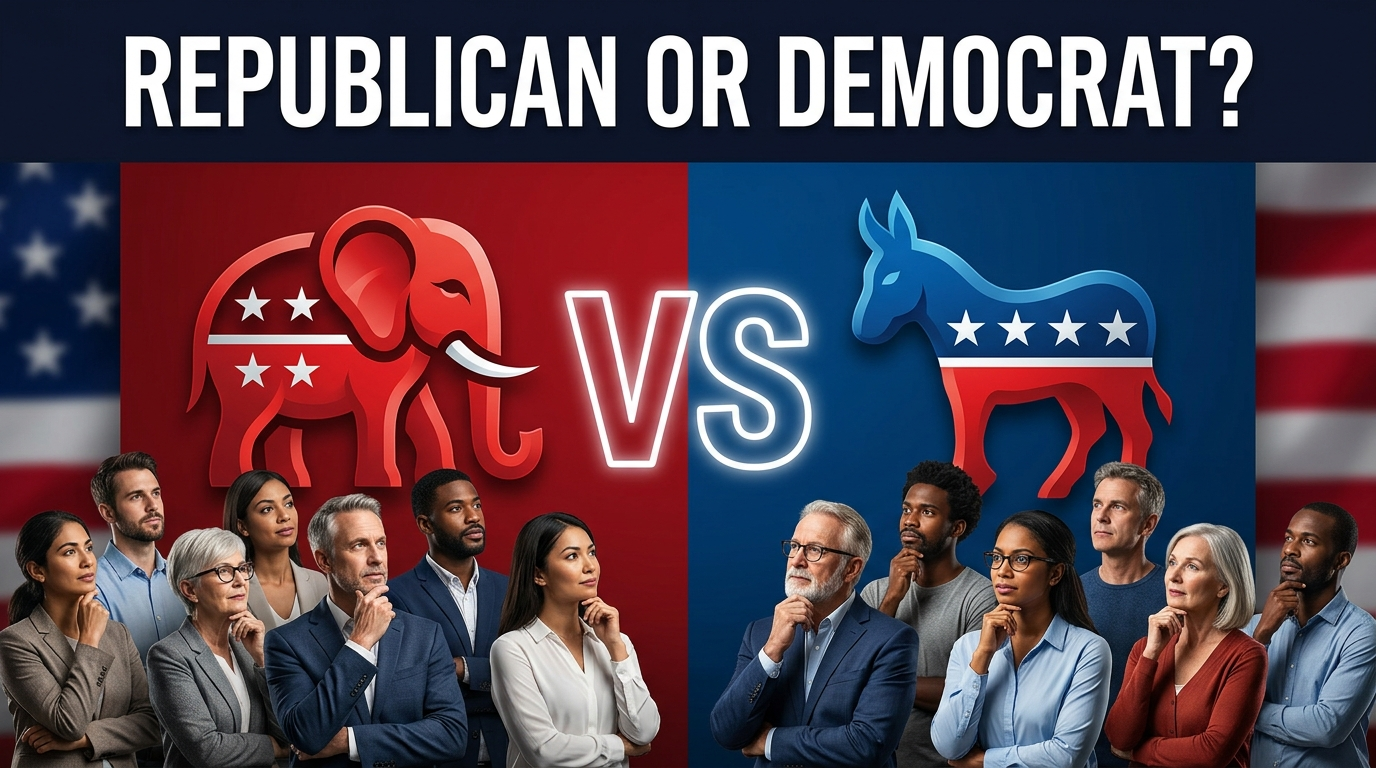
I still remember the first time I tried to follow a political discussion online. A friend asked whether I supported Republicans or Democrats. I smiled and answered confidently. A few minutes later, I realized I had mixed up the two parties completely. It was embarrassing.
The truth is that many people search for “Republican or Democrat” because they want a simple explanation. Political news can feel confusing. Elections often focus on Republicans and Democrats, but not everyone knows what each party stands for.
Some people are new voters. Others are students, immigrants, or simply curious citizens trying to understand American politics. They often wonder: What is the difference? Which party believes what? Why do people strongly support one side or the other?
The confusion becomes even greater when politicians, news channels, and social media users use political labels without explaining them clearly. As a result, many people feel lost when trying to understand elections, policies, and debates.
If you’ve ever felt confused about Republican vs Democrat, you’re not alone. This guide breaks everything down into simple, easy-to-understand language so you can finally understand the key differences and never mix them up again.
✅ Republican or Democrat – Quick Answer
Republicans and Democrats are the two major political parties in the United States.
- Republicans generally support smaller government, lower taxes, and more individual responsibility.
- Democrats generally support a larger government role in social programs and public services.
Examples:
- A Republican may favor tax cuts for businesses.
- A Democrat may support expanding healthcare programs.
- Both parties compete in local, state, and national elections.
📖 What Does Republican or Democrat Mean?
A Republican is a member or supporter of the Republican Party.
A Democrat is a member or supporter of the Democratic Party.
These two parties have dominated American politics for more than a century. Most presidents, senators, governors, and members of Congress belong to one of these parties.
Republicans are often associated with conservative political views. They usually emphasize limited government involvement in the economy, lower taxes, and strong national defense.
Democrats are often associated with liberal political views. They generally support social programs, environmental protections, labor rights, and broader government services.
Examples
- A voter chooses a Republican candidate because they support lower taxes.
- A voter chooses a Democrat candidate because they support expanded healthcare.
- Some voters switch between parties depending on the issue.
🧠 Why Do People Confuse Republican or Democrat?
Many people confuse Republicans and Democrats because politics is complicated.
Several reasons cause this confusion:
1. Political Labels Change Over Time
The positions of both parties have evolved throughout American history. This makes it harder to understand older political discussions.
2. Media Overload
News channels, websites, and social media often assume viewers already understand political terms.
3. Similar Election Processes
Both parties participate in the same elections and government system, making them appear similar to newcomers.
4. Complex Policy Issues
Many political issues have multiple viewpoints. Not every Republican or Democrat agrees on every topic.
5. Political Stereotypes
People often hear simplified stereotypes that do not fully explain what either party believes.
⚖️ Republican vs Democrat
| Feature | Republican | Democrat |
| Political Position | Generally Conservative | Generally Liberal |
| Government Role | Smaller Government | Larger Government Role |
| Taxes | Lower Taxes Preferred | More Public Spending |
| Healthcare | More Private Options | More Government Programs |
| Business Regulation | Less Regulation | More Regulation |
| Social Issues | More Traditional Views | More Progressive Views |
| Popular Color | Red | Blue |
| Election Symbol | Elephant | Donkey |
Understanding the Difference
The biggest difference is how each party views the role of government.
Republicans often believe individuals and businesses should have more freedom with less government involvement.
Democrats often believe government should play a stronger role in helping citizens through programs and regulations.
American vs British Usage
Unlike spelling differences such as “color” and “colour,” Republican and Democrat are American political terms.
However, people in the United Kingdom and other countries still use these terms when discussing U.S. politics.
| Usage Area | Republican | Democrat |
| United States | Very Common | Very Common |
| United Kingdom | Used When Discussing U.S. Politics | Used When Discussing U.S. Politics |
| Global Media | Common | Common |
Which Is More Common Globally?
Both terms are equally common because they represent the two largest political parties in the United States, one of the most influential countries in the world.
💬 Real-Life Examples of Republican or Democrat
Emails
- “The candidate is running as a Republican.”
- “She has been a Democrat for many years.”
Social Media
- “Are you Republican or Democrat?”
- “The debate focused on Republican and Democrat policies.”
Workplace Conversations
- “Many employees discussed the Republican candidate.”
- “Some coworkers supported Democrat proposals.”
Daily Conversation
- “My parents usually vote Republican.”
- “My neighbor identifies as a Democrat.”
⚠️ Common Mistakes to Avoid
1. Assuming All Republicans Think the Same
❌ Wrong: Every Republican supports every Republican policy.
✅ Correct: Republicans often have different opinions.
2. Assuming All Democrats Agree
❌ Wrong: Every Democrat supports every Democrat proposal.
✅ Correct: Democrats also have diverse viewpoints.
3. Using Party Labels as Insults
❌ Wrong: Political labels automatically define someone’s character.
✅ Correct: Party affiliation is only one part of a person’s beliefs.
4. Ignoring Independent Voters
❌ Wrong: Everyone is Republican or Democrat.
✅ Correct: Many voters identify as independent.
5. Believing Every Online Claim
❌ Wrong: Social media always explains politics accurately.
✅ Correct: Verify information using trusted sources.
🎯 Pro Tips to Remember Republican or Democrat
1. Think “Red = Republican”
Many election maps use red for Republican states.
2. Think “Blue = Democrat”
Democratic states are often shown in blue.
3. Remember Government Size
Republicans generally prefer smaller government.
Democrats generally support more government programs.
4. Focus on Core Ideas
Don’t memorize every policy. Learn the main philosophy first.
5. Avoid Stereotypes
Real people often have mixed political beliefs.
📊 Usage Trends & Popularity
Republican and Democrat are among the most searched political terms in the United States.
Interest usually increases during:
- Presidential elections
- Congressional elections
- Political debates
- Major national events
Democrat and Republican searches are especially popular in the United States, but global interest rises whenever major American elections occur.
Because U.S. politics affects international news, both terms are widely recognized around the world.
❓ FAQs
1. What is the main difference between Republicans and Democrats?
Republicans generally support smaller government and lower taxes, while Democrats generally support larger government involvement in social programs.
2. Which party is conservative?
The Republican Party is generally considered the conservative party in the United States.
3. Which party is liberal?
The Democratic Party is generally considered the liberal party in the United States.
4. Do all Republicans agree with each other?
No. Republicans often disagree on various political issues.
5. Do all Democrats have the same beliefs?
No. Democrats have a wide range of opinions and priorities.
6. Can someone switch parties?
Yes. Voters and politicians can change party affiliation.
7. What do the colors red and blue represent?
Red commonly represents Republicans, while blue represents Democrats.
8. Are there political parties besides Republicans and Democrats?
Yes. Independent, Libertarian, Green, and other parties also exist.
9. Why are Republicans and Democrats so important?
They are the two largest political parties and dominate most major elections in the United States.
Conclusion
Understanding Republican or Democrat does not have to be difficult. Many people feel confused when they first encounter American politics, especially because news reports, social media discussions, and election coverage often assume everyone already understands the basics.
At the simplest level, Republicans generally favor smaller government, lower taxes, and more individual responsibility. Democrats generally support a stronger government role in social programs, healthcare, and public services. While these descriptions are broad, they provide a useful starting point for understanding political debates and elections.
It is also important to remember that political beliefs are rarely identical within a party. Not every Republican agrees with every Republican policy, and not every Democrat supports every Democrat proposal. Real political opinions are often more complex than labels suggest.
The best approach is to focus on policies, values, and issues rather than stereotypes. Learning the differences between Republicans and Democrats helps you better understand elections, government decisions, and national conversations.
The key takeaway: Republicans and Democrats represent different political philosophies, but understanding both sides is the first step toward becoming a more informed citizen.

“I’m David Crystal, a grammar expert at Grammeriffy.com. I help readers master English with clear, practical writing tips.”