I once came across a search query that made me stop and read it twice: “bend or population.”
At first, I thought it had to be a typo. After all, a bend and a population are completely different things. One refers to a curve or change in direction, while the other refers to the number of people living in a place.
Yet unusual search terms like this appear online all the time. Sometimes people are researching geography, statistics, city planning, maps, rivers, or demographics and accidentally compare unrelated words. Other times, they simply want to understand the meanings of two terms they encountered in the same article.
The confusion grows because both words can appear in discussions about cities, regions, transportation, and geography. For example, a river bend may influence where a population settles.
If you’ve searched for “bend or population,” you’re probably looking for a simple explanation of what each term means and how they differ.
The good news is that the distinction is straightforward.
In this guide, you’ll learn the meaning of bend and population, why people might connect them, how they are used, and the key differences between these two very different terms.
✅ Bend or Population – Quick Answer
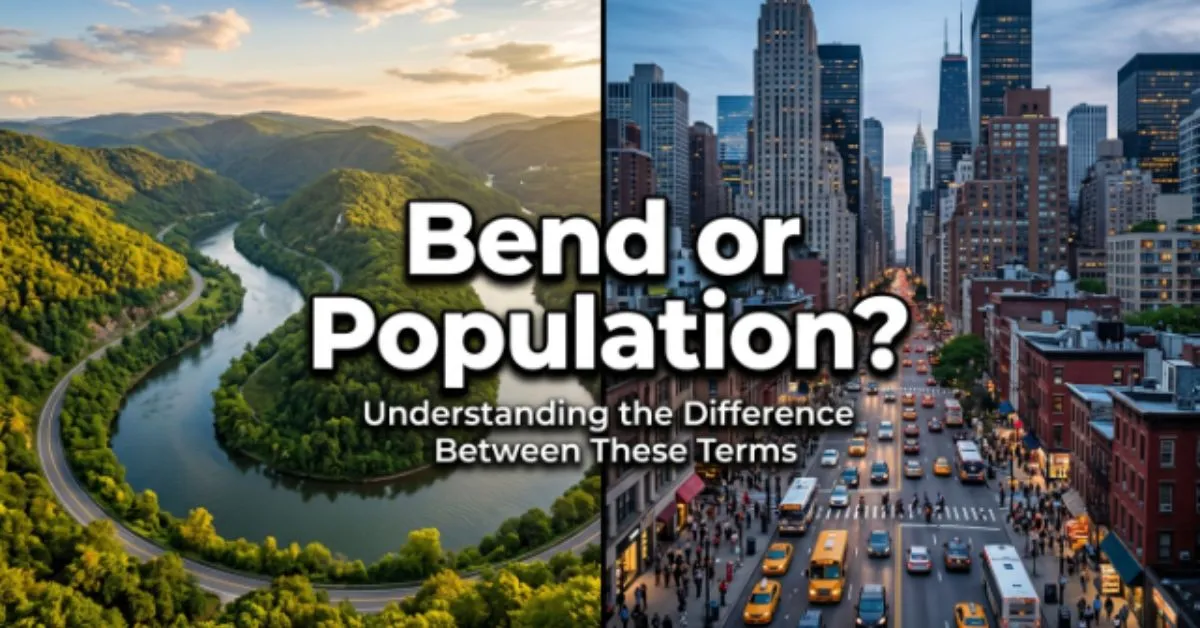
Bend refers to a curve, turn, or change in direction.
Population refers to the number of people, animals, or living organisms in a particular area.
Examples:
- The road makes a sharp bend.
- The river forms a large bend.
- The city’s population is growing.
📖 What Does Bend or Population Mean?
What Does Bend Mean?
A bend is a curve or turn.
It can refer to:
- Roads
- Rivers
- Objects
- Body movements
Examples:
- The road bends near the mountain.
- There is a sharp bend in the river.
- Bend your knees slightly.
What Does Population Mean?
Population refers to the total number of people living in a particular place.
It can also refer to groups of animals or organisms.
Examples:
- The population of the city is increasing.
- The country has a large population.
- Scientists studied the fish population.
🧠 Why Do People Confuse Bend or Population?
1. Geographic Discussions
Both words can appear in geography lessons.
2. City Planning Topics
River bends often influence population growth.
3. Search Errors
People sometimes type unrelated words together.
4. Academic Research
Maps and demographics often include both terms.
5. Lack of Context
Without context, the connection seems unclear.
⚖️ Bend vs Population
| Feature | Bend | Population |
| Type | Physical Shape | Statistical Measure |
| Refers To | Curves or Turns | Number of People |
| Used In | Geography, Roads, Rivers | Demographics, Statistics |
| Physical Object | Yes | No |
| Measurement | Shape or Direction | Count of Individuals |
Main Difference
A bend describes a shape or direction.
A population describes how many people live in an area.
American vs British Usage
The meanings are essentially the same in American and British English.
| Region | Bend | Population |
| USA | Common | Common |
| UK | Common | Common |
| Canada | Common | Common |
| Australia | Common | Common |
Which Term Is More Common?
Population appears frequently in statistics and news, while bend is common in geography and everyday conversation.
💬 Real-Life Examples of Bend or Population
Geography
“The river makes a wide bend.”
Transportation
“Slow down near the bend.”
Demographics
“The population increased by 5%.”
Education
“Students studied the country’s population.”
City Planning
“A river bend influenced settlement patterns and population growth.”
⚠️ Common Mistakes to Avoid
1. Treating Them As Similar Concepts
❌ Bend and population mean the same thing.
✅ They refer to completely different ideas.
2. Using Population For Physical Shapes
❌ The road has a population.
✅ The road has a bend.
3. Using Bend For Demographics
❌ The city’s bend is 2 million.
✅ The city’s population is 2 million.
4. Ignoring Context
❌ Choose either word.
✅ Use the word that matches the topic.
5. Mixing Geography With Statistics
❌ A population is a curve.
✅ A population is a count of people.
🎯 Pro Tips to Remember Bend or Population
Tip 1
Think bend = curve.
Tip 2
Think population = people.
Tip 3
Roads and rivers have bends.
Tip 4
Cities and countries have populations.
Tip 5
If you’re counting people, use population.
📊 Usage Trends & Popularity
Bend
Often appears in:
- Road signs
- Maps
- Geography books
- Navigation guides
Population
Often appears in:
- Census reports
- News articles
- Government statistics
- Demographic studies
Which Is More Popular?
Population is searched frequently because of interest in cities, countries, and demographics.
❓ FAQs
1. What is a bend?
A bend is a curve or turn in something such as a road or river.
2. What is a population?
A population is the total number of people living in a specific area.
3. Are bend and population related?
Not directly, though geographic features can influence population distribution.
4. Can a river bend affect population growth?
Yes. Settlements often develop near rivers.
5. Is population only used for humans?
No. It can also refer to animals and other organisms.
6. Is bend a noun or a verb?
It can be both a noun and a verb.
7. How is population measured?
Through surveys, censuses, and demographic studies.
8. Which word is used in geography?
Both can be used in geography but with different meanings.
9. Are the words interchangeable?
No. They describe entirely different concepts.
Conclusion
The difference between bend and population is simple once you understand their meanings.
A bend is a curve, turn, or change in direction. It is commonly used when talking about roads, rivers, and physical movement.
Population, on the other hand, refers to the number of people or living organisms in a particular area. It is a key term in demographics, statistics, economics, and government planning.
Although the two words may occasionally appear in the same geographic discussions, they are not interchangeable. One describes shape and direction, while the other describes quantity and distribution of living beings.
Remember this easy rule: a bend is a curve, while a population is a count of people.

“I’m David Crystal, a grammar expert at Grammeriffy.com. I help readers master English with clear, practical writing tips.”