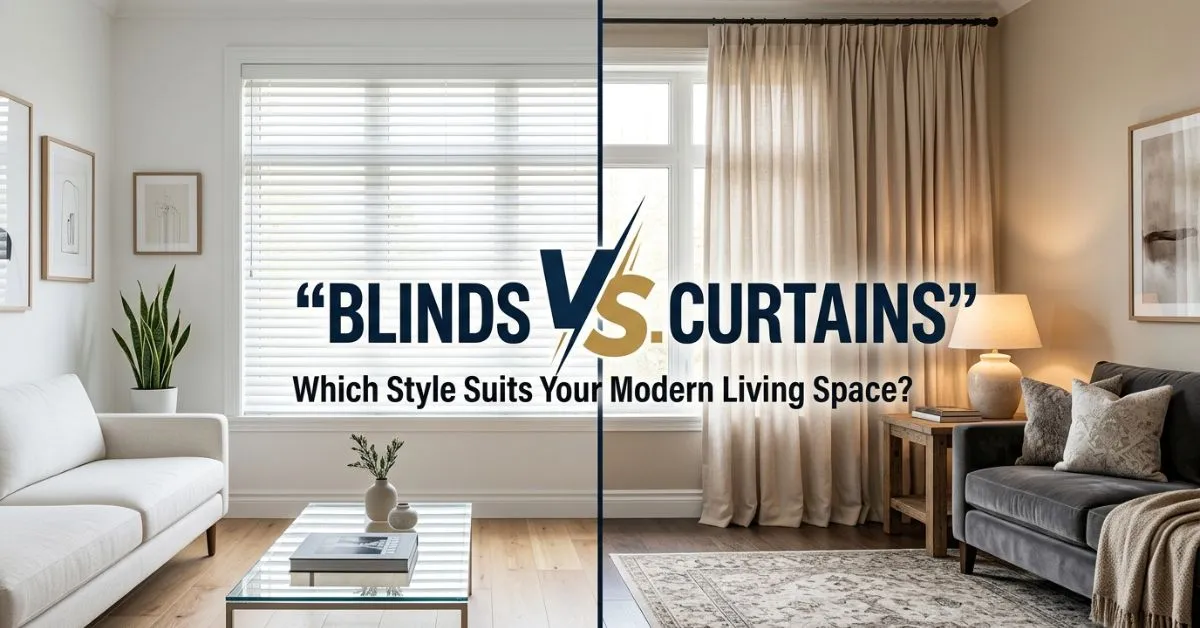
I still remember moving into my first apartment and standing in front of a large empty window. I thought choosing a window covering would be easy. Then I walked into a home store.
Rows of blinds.
Rows of curtains.
Hundreds of colors, styles, materials, and prices.
I spent nearly an hour comparing options and left more confused than when I arrived.
If you’ve searched for “blinds or curtains,” you’re probably facing the same challenge. Maybe you’re decorating a new home. Maybe you’re renovating a room. Or perhaps you’re simply trying to improve privacy, control sunlight, or make your space look more stylish.
The problem is that both blinds and curtains offer benefits. Both can improve a room’s appearance. Both can help with privacy and light control. Yet they work differently and suit different needs.
Many homeowners struggle to decide which option is better because the answer depends on the room, budget, style preferences, and daily habits.
The good news is that once you understand the key differences, choosing becomes much easier.
In this guide, you’ll learn exactly how blinds and curtains compare, where each works best, common mistakes to avoid, and the simple rule that can help you make the right choice for your home.
Keep reading because one small design decision can completely change the look and feel of a room.
✅ Blinds or Curtains – Quick Answer
Blinds are window coverings made of slats or panels that can be adjusted to control light and privacy.
Curtains are fabric panels that hang from a rod and add softness, style, and insulation.
Examples:
- Office windows often use blinds.
- Bedrooms commonly use curtains.
- Many homes combine both for maximum privacy and style.
📖 What Does Blinds or Curtains Mean?
When people search for “blinds or curtains,” they are comparing two popular window treatment options.
What Are Blinds?
Blinds are window coverings made from materials such as:
- Wood
- Faux wood
- Aluminum
- Vinyl
Most blinds use adjustable slats.
These slats can tilt open or closed to control sunlight.
What Are Curtains?
Curtains are fabric panels that hang from a rod above a window.
They come in many styles, including:
- Blackout curtains
- Sheer curtains
- Decorative curtains
Curtains often add warmth and personality to a room.
Simple Example
Think of blinds as adjustable sunglasses for your windows.
Think of curtains as stylish clothing that also provides privacy.
Both serve a purpose but create different looks.
🧠 Why Do People Confuse Blinds or Curtains?
Several reasons cause confusion.
Both Cover Windows
At first glance, blinds and curtains appear to solve the same problem.
Both help with:
- Privacy
- Sunlight control
- Interior design
Similar Prices in Some Cases
Many shoppers assume one is always cheaper.
In reality, prices vary depending on size, materials, and quality.
Mixed Design Advice
Home improvement websites often recommend both options.
This can make decision-making difficult.
Personal Preferences
What looks great in one home may not work well in another.
As a result, people often hear conflicting opinions.
⚖️ Blinds or Curtains vs Shades
| Feature | Blinds | Curtains |
| Spelling | Blinds | Curtains |
| Meaning | Slatted window covering | Fabric window covering |
| Usage | Light control and privacy | Style, privacy, insulation |
| Material | Wood, vinyl, metal | Fabric |
| Region | US & UK | US & UK |
Understanding the Difference
The biggest difference is structure.
Blinds use adjustable slats.
Curtains use fabric panels.
Blinds offer precise light control.
Curtains often provide a softer and more decorative appearance.
American vs British Usage
Both terms are widely used in the United States and the United Kingdom.
| Feature | American English | British English |
| Blinds | Common | Common |
| Curtains | Common | Common |
| Meaning | Same | Same |
| Home Usage | Same | Same |
Which Version Is More Common Globally?
Both words are universally understood in English-speaking countries.
Curtains are often associated with traditional home decor.
Blinds are frequently linked to modern and minimalist interiors.
💬 Real-Life Examples of Blinds or Curtains
In Emails
“We’re deciding between blinds and curtains for the living room renovation.”
On Social Media
“Should I install blinds or curtains in my new apartment?”
At Work
“The office uses blinds to reduce glare on computer screens.”
In Daily Conversation
“I chose curtains because they made the room feel warmer.”
During Home Renovations
“We compared several blind and curtain styles before making a decision.”
Interior Design Discussions
“Layering curtains over blinds creates a luxury look.”
⚠️ Common Mistakes to Avoid
1. Choosing Style Over Function
❌ Wrong: Buying based only on appearance.
✅ Correct: Consider privacy and light control too.
2. Ignoring Room Purpose
❌ Wrong: Using sheer curtains in a room needing darkness.
✅ Correct: Match window treatments to room needs.
3. Forgetting Maintenance
❌ Wrong: Assuming all window coverings clean easily.
✅ Correct: Some fabrics and materials require more care.
4. Measuring Incorrectly
❌ Wrong: Guessing window dimensions.
✅ Correct: Measure carefully before buying.
5. Overlooking Energy Efficiency
❌ Wrong: Ignoring insulation benefits.
✅ Correct: Some curtains help reduce heat loss and sunlight.
6. Assuming One Option Fits Every Room
❌ Wrong: Using the same solution everywhere.
✅ Correct: Different rooms often benefit from different treatments.
🎯 Pro Tips to Remember Blinds or Curtains
1. Think “Control vs Comfort”
Blinds = Control
Curtains = Comfort
2. Use the Slat Rule
If it has adjustable slats, it’s a blind.
3. Remember Fabric Equals Curtains
Fabric panels usually mean curtains.
4. Match Function First
Decide what you need before choosing a style.
5. Consider Layering
Many designers combine blinds and curtains for the best of both worlds.
📊 Usage Trends & Popularity
The keyword “blinds or curtains” remains popular among homeowners and renters.
Why People Search It
Common search topics include:
- Best window treatments
- Modern home decor
- Privacy solutions
- Light-blocking options
United States Trends
Blinds are especially popular in:
- Offices
- Apartments
- Modern homes
Curtains are common in:
- Bedrooms
- Living rooms
- Traditional homes
Global Popularity
Both remain widely used worldwide.
Many homeowners now combine blinds and curtains for improved appearance and functionality.
Growing Design Trends
Popular trends include:
- Motorized blinds
- Blackout curtains
- Layered window treatments
- Energy-efficient fabrics
FAQs
1. Are blinds better than curtains?
Neither is universally better. The best choice depends on your needs, style, and room type.
2. Which provides better privacy?
Both can provide privacy when chosen and installed properly.
3. Are curtains cheaper than blinds?
Costs vary depending on materials, size, and quality.
4. Which is easier to clean?
Many blinds can be wiped clean, while curtains may require washing or dry cleaning.
5. Do curtains help with insulation?
Yes. Some thick curtains can improve insulation and reduce heat transfer.
6. Are blinds good for bedrooms?
Yes. Many homeowners use blinds in bedrooms, especially blackout styles.
7. Can I use both blinds and curtains?
Yes. Combining both is a popular design solution.
8. Which looks more modern?
Many modern interiors use blinds, though contemporary curtain styles are also popular.
9. Which lasts longer?
Durability depends on material quality, maintenance, and daily use.
Conclusion
Choosing between blinds or curtains can feel overwhelming at first, especially with so many styles, materials, and opinions available. The good news is that understanding the basic differences makes the decision much easier.
Blinds are known for precise light control, clean lines, and practical functionality. They are often used in offices, kitchens, and modern homes where adjustable privacy and sunlight management are important.
Curtains bring softness, warmth, and decorative appeal to a room. They can improve comfort, reduce outside light, and create a welcoming atmosphere in bedrooms and living spaces.
The best choice depends on your goals. If light control is your top priority, blinds may be the better option. If style and comfort matter most, curtains may be the perfect fit. Many homeowners discover that combining both creates an attractive and highly functional solution.
Before making a decision, consider privacy needs, room purpose, cleaning requirements, energy efficiency, and overall design style.
The key takeaway is simple:
Blinds offer control. Curtains offer comfort. Together, they can create the perfect window treatment for almost any home.

“I’m Bill Bryson, a grammar expert at Grammeriffy.com. I share clear tips and guidance to help readers master English confidently.”