I still remember the panic I felt while finishing a research paper the night before it was due. I had spent hours writing, editing, and checking sources. Then I noticed something terrifying: my professor required APA format, but I had written the entire paper in MLA format.
At the time, I thought MLA and APA were basically the same thing. Both required citations. Both included reference pages. How different could they be?
As it turns out, they are very different.
If you’ve searched for “MLA or APA,” you’re probably trying to figure out which citation style you should use. Maybe you’re writing a school essay, a college research paper, a psychology report, or a literature review. Whatever the reason, choosing the wrong format can cost valuable points.
The confusion happens because both citation styles help writers give credit to sources. However, they follow different rules, serve different academic fields, and organize information in unique ways.
The good news is that understanding the difference between MLA and APA is easier than most students think.
In this guide, you’ll learn exactly what MLA and APA mean, when to use each one, key differences, common mistakes, and simple tricks to remember them forever.
Keep reading because one simple rule can help you choose the right citation style almost every time.
✅ MLA or APA – Quick Answer
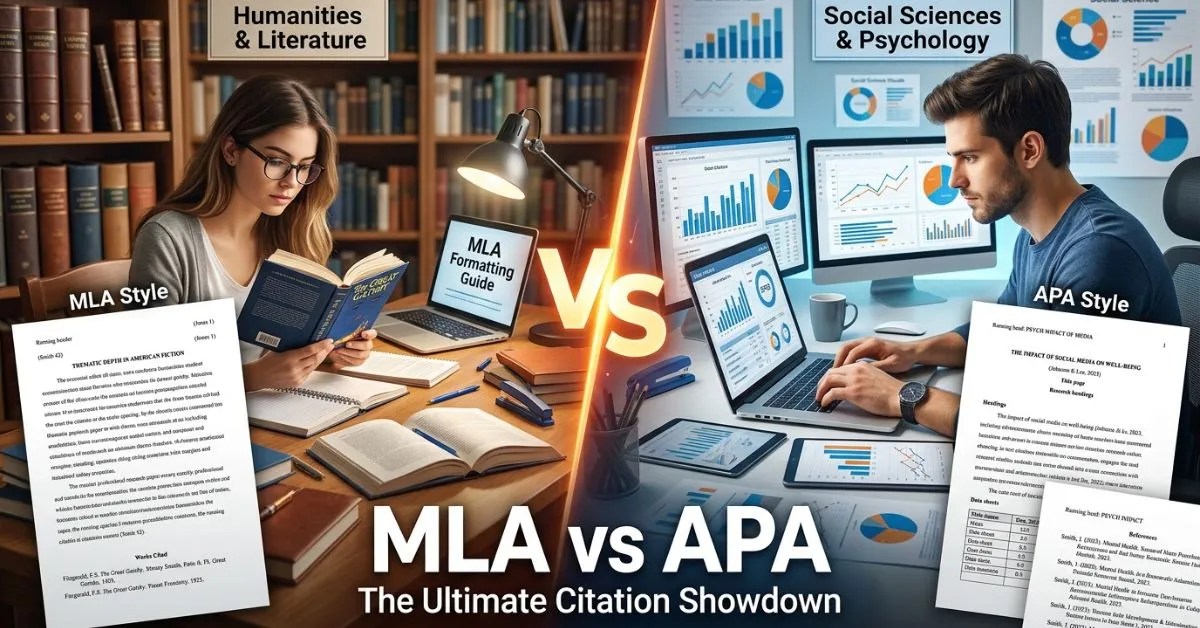
MLA (Modern Language Association) is mainly used for literature, language, and humanities subjects.
APA (American Psychological Association) is mainly used for psychology, education, social sciences, and many scientific fields.
Examples:
- English essay → MLA
- Psychology paper → APA
- Sociology research project → APA
📖 What Does MLA or APA Mean?
MLA and APA are citation styles used to give credit to information sources.
They help readers find original sources and prevent plagiarism.
What Is MLA?
MLA stands for Modern Language Association.
It is commonly used in:
- English
- Literature
- Language studies
- Humanities
MLA focuses heavily on authors and page numbers.
What Is APA?
APA stands for American Psychological Association.
It is commonly used in:
- Psychology
- Education
- Sociology
- Business
- Social sciences
APA places greater emphasis on publication dates.
Simple Examples
MLA In-Text Citation:
(Smith 45)
APA In-Text Citation:
(Smith, 2023, p. 45)
🧠 Why Do People Confuse MLA or APA?
Many students mix them up because both styles serve similar purposes.
Both Use Citations
Each style requires:
- In-text citations
- A source list
- Proper formatting
Similar Academic Purpose
Both styles help prevent plagiarism.
Students Use Multiple Subjects
A student may use MLA in English class and APA in Psychology class during the same semester.
Formatting Differences Seem Small
At first glance, the styles appear similar.
However, professors can quickly spot formatting mistakes.
⚖️ MLA or APA vs Each Other
| Feature | MLA | APA |
| Full Name | Modern Language Association | American Psychological Association |
| Common Subjects | Literature, Humanities | Psychology, Social Sciences |
| In-Text Citation | Author + Page | Author + Year |
| Reference Page | Works Cited | References |
| Date Importance | Less emphasis | Strong emphasis |
| Popular In | Schools and humanities | Universities and research |
Key Difference
MLA focuses more on the author and page number.
APA focuses more on the author and publication year.
🇺🇸 vs 🇬🇧 American vs British Usage
| Feature | United States | United Kingdom |
| MLA Usage | Common | Less common |
| APA Usage | Very common | Common |
| Academic Preference | Depends on subject | Depends on institution |
Which Style Is More Common Globally?
APA is generally more common worldwide because many scientific and social science journals use it.
MLA remains highly popular in humanities and literature courses.
💬 Real-Life Examples of MLA or APA
In School Essays
“My English teacher requires MLA format.”
In Psychology Courses
“Our research report must follow APA guidelines.”
In College Assignments
“Check the syllabus to see whether MLA or APA is required.”
In Academic Writing
“The professor deducted points for incorrect APA citations.”
In Research Projects
“Most social science journals use APA style.”
In Online Learning Platforms
“The tutorial explains MLA and APA formatting.”
⚠️ Common Mistakes to Avoid
1. Using MLA When APA Is Required
❌ Wrong: Submitting an APA paper in MLA style.
✅ Correct: Follow assignment instructions carefully.
2. Mixing Citation Styles
❌ Wrong: Combining MLA and APA citations.
✅ Correct: Use only one style throughout the paper.
3. Forgetting Publication Years in APA
❌ Wrong: Omitting dates.
✅ Correct: APA strongly emphasizes publication years.
4. Using the Wrong Reference Page Title
❌ Wrong: Calling an APA page “Works Cited.”
✅ Correct: APA uses “References.”
5. Ignoring Page Numbers in MLA
❌ Wrong: Leaving out page numbers when needed.
✅ Correct: MLA often includes page references.
6. Trusting Auto-Generated Citations Without Checking
❌ Wrong: Assuming software is always correct.
✅ Correct: Verify every citation manually.
🎯 Pro Tips to Remember MLA or APA
1. Think Subjects
MLA = Literature
APA = Psychology
2. Remember the Date Rule
APA loves publication years.
MLA focuses more on page numbers.
3. Check the Assignment Sheet
Professors usually specify the required style.
4. Learn One Style at a Time
Master MLA first, then APA, or vice versa.
5. Use Official Style Guides
Reliable guides prevent formatting mistakes.
📊 Usage Trends & Popularity
The search term “MLA or APA” remains highly popular among students.
Why People Search It
Common reasons include:
- School assignments
- College research papers
- Citation questions
- Formatting concerns
United States
Both styles are widely taught.
MLA is especially common in English classes.
APA dominates psychology and social science courses.
United Kingdom
Universities may use APA, Harvard, or institution-specific styles.
Global Popularity
APA is generally the most widely used academic style worldwide due to its role in scientific publishing.
FAQs
1. What does MLA stand for?
MLA stands for Modern Language Association.
2. What does APA stand for?
APA stands for American Psychological Association.
3. Which is easier, MLA or APA?
Many students find MLA simpler because the formatting rules are often less detailed.
4. Is APA more common than MLA?
APA is generally more common in scientific and social science fields.
5. What subjects use MLA?
English, literature, language studies, and humanities often use MLA.
6. What subjects use APA?
Psychology, education, sociology, business, and social sciences commonly use APA.
7. Can I use MLA instead of APA?
Only if your instructor specifically allows it.
8. Why does APA use dates?
APA emphasizes recent research, making publication dates important.
9. What happens if I use the wrong style?
You may lose points or fail to meet assignment requirements.
Conclusion
Understanding MLA or APA is essential for academic success. While both citation styles help writers give credit to sources, they serve different purposes. MLA is primarily used in literature and humanities, while APA is widely used in psychology, education, and social sciences.
The biggest difference is simple: MLA focuses on authors and page numbers, while APA places strong emphasis on publication dates. Knowing this distinction can help you choose the correct format quickly.
Many students struggle because both styles look similar at first. However, once you learn the basic rules, the differences become much easier to recognize. The key is always checking your assignment requirements before you start writing.
Whether you’re preparing a research paper, essay, thesis, or report, using the correct citation style shows professionalism and academic integrity.
The key takeaway: if you’re writing about literature, think MLA. If you’re writing about research and social sciences, think APA.

“I’m Agatha Christie, the grammar expert behind Grammeriffy.com. I help readers master English with clear, reliable writing tips.”