I still remember the first time I felt pain during a bowel movement. It was sharp, sudden, and honestly a little scary. After seeing a small amount of blood, I immediately searched online and found two terms popping up everywhere: hemorrhoid and fissure.
The problem? They seemed almost identical.
Both can cause pain, bleeding, and discomfort in the anal area. Both are common. And both are often confused with each other. I spent hours reading articles, trying to figure out what was actually happening.
If you’ve found yourself asking whether your symptoms are caused by a hemorrhoid or a fissure, you’re not alone. Thousands of people search this question every month because the symptoms can overlap.
Understanding the difference matters because the causes, pain levels, treatment options, and recovery times can be very different.
In this guide, you’ll learn exactly what hemorrhoids and fissures are, how to tell them apart, which symptoms are most common, and when it’s time to see a doctor. By the end, you’ll know the key signs that separate these two conditions and avoid one of the most common health-related misunderstandings.
✅ Hemorrhoid or Fissure – Quick Answer
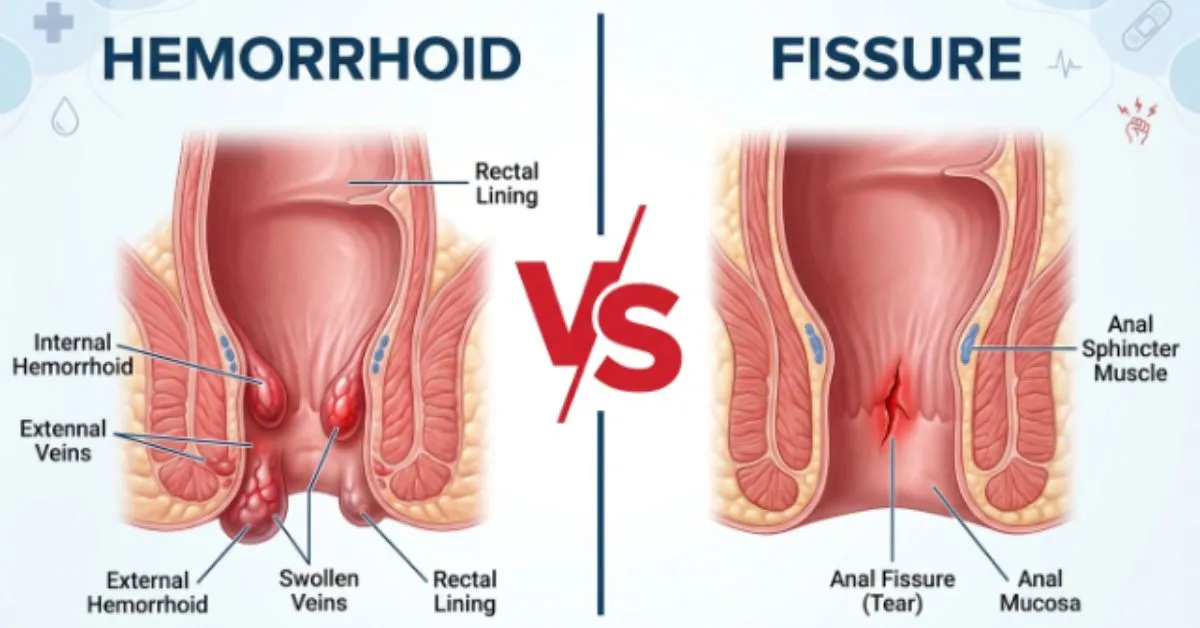
A hemorrhoid is a swollen vein in or around the anus, while an anal fissure is a small tear in the lining of the anus.
Examples:
- A hemorrhoid may cause itching, swelling, or painless bleeding.
- A fissure often causes sharp pain during bowel movements.
- Bright red blood can occur with both conditions.
The biggest difference is that fissures usually cause intense pain, while hemorrhoids often cause pressure, itching, or mild discomfort.
📖 What Does Hemorrhoid or Fissure Mean?
A hemorrhoid is an enlarged or swollen vein in the rectum or around the anus. It is similar to a varicose vein that can develop due to pressure from straining, constipation, pregnancy, or prolonged sitting.
Common symptoms include:
- Itching around the anus
- Swelling
- Bleeding during bowel movements
- A lump near the anal opening
A fissure, on the other hand, is a small cut or tear in the delicate skin lining the anus.
Common symptoms include:
- Sharp pain during bowel movements
- Burning sensation afterward
- Bright red blood on toilet paper
- Muscle spasms in the anal area
Examples
- If sitting feels uncomfortable and you notice a swollen lump, it may be a hemorrhoid.
- If passing stool feels like being cut by a sharp object, it may be a fissure.
- If bleeding occurs without significant pain, hemorrhoids are often more likely.
🧠 Why Do People Confuse Hemorrhoid or Fissure?
People confuse these conditions because they affect the same area and share several symptoms.
Some reasons include:
- Both can cause bright red bleeding.
- Both may develop after constipation.
- Both are linked to straining during bowel movements.
- Both create discomfort around the anus.
Many people assume that any bleeding or pain in the anal area must be hemorrhoids because hemorrhoids are more commonly discussed. As a result, fissures are often overlooked.
Another reason is embarrassment. Many people avoid seeing a healthcare professional and try to diagnose themselves online.
⚖️ Hemorrhoid vs Fissure
| Feature | Hemorrhoid | Fissure |
| Condition Type | Swollen vein | Small tear in skin |
| Main Symptom | Itching, swelling, pressure | Sharp pain |
| Bleeding | Common | Common |
| Pain Level | Mild to moderate | Often severe |
| Lump Present | Often yes | Usually no |
| Trigger | Pressure and straining | Hard stools or trauma |
| Healing Time | Days to weeks | Weeks to months |
| Medical Term | Hemorrhoids | Anal fissure |
Understanding the Difference
The easiest way to remember the difference is this:
- Hemorrhoid = swollen vein
- Fissure = torn skin
A hemorrhoid is more like a bulge, while a fissure is more like a paper cut.
American vs British Usage
Unlike many spelling questions, the terms hemorrhoid and fissure are medical conditions rather than alternative spellings.
However, there is one spelling difference.
| American English | British English |
| Hemorrhoid | Haemorrhoid |
| Anal fissure | Anal fissure |
In the United States, “hemorrhoid” is standard.
In the United Kingdom, “haemorrhoid” is preferred.
Globally, both spellings are understood by healthcare professionals.
💬 Real-Life Examples of Hemorrhoid or Fissure
In an Email
“I’ve been experiencing pain during bowel movements and would like to schedule an appointment to determine whether it’s a hemorrhoid or fissure.”
On Social Media
“I thought I had hemorrhoids, but my doctor diagnosed an anal fissure.”
In the Workplace
“I need a medical appointment this afternoon due to a health issue.”
In Daily Conversation
“I’ve had discomfort for a few days and want to find out if it’s a hemorrhoid or a fissure.”
⚠️ Common Mistakes to Avoid
1. Assuming All Bleeding Means Hemorrhoids
❌ Wrong: Bleeding always means hemorrhoids.
✅ Correct: Bleeding can occur with hemorrhoids or fissures.
2. Ignoring Severe Pain
❌ Wrong: Sharp pain is normal with hemorrhoids.
✅ Correct: Severe pain often points toward a fissure.
3. Self-Diagnosing Without Medical Advice
❌ Wrong: Internet searches replace medical evaluation.
✅ Correct: Persistent symptoms should be checked by a doctor.
4. Delaying Treatment
❌ Wrong: Symptoms will always disappear on their own.
✅ Correct: Some cases need professional care.
5. Confusing a Lump With a Tear
❌ Wrong: Every anal problem is a fissure.
✅ Correct: A visible lump is often associated with hemorrhoids.
🎯 Pro Tips to Remember Hemorrhoid or Fissure
Tip 1
Think of a hemorrhoid as a swollen vein.
Tip 2
Think of a fissure as a paper cut.
Tip 3
Pain usually points toward a fissure.
Tip 4
Itching and swelling often point toward hemorrhoids.
Tip 5
When symptoms overlap, seek professional medical advice instead of guessing.
📊 Usage Trends & Popularity
The term “hemorrhoid” is searched more frequently than “fissure” because hemorrhoids are widely discussed in health articles and advertisements.
Current trends show:
- Hemorrhoids are one of the most common adult digestive complaints.
- Anal fissures are common but less recognized.
- Searches increase when people experience pain or bleeding during bowel movements.
In the United States, hemorrhoid-related searches significantly outnumber fissure-related searches.
Globally, both conditions remain common topics in digestive health discussions.
❓ FAQs
1. Is a fissure more painful than a hemorrhoid?
Yes. Fissures often cause sharp, intense pain, especially during bowel movements.
2. Can hemorrhoids and fissures occur together?
Yes. Some people develop both conditions at the same time.
3. Do both conditions cause bleeding?
Yes. Bright red blood is common with both hemorrhoids and fissures.
4. Which condition heals faster?
Many hemorrhoids improve within days or weeks. Fissures may take longer to heal.
5. Can constipation cause both?
Yes. Hard stools and straining are major risk factors for both conditions.
6. Do hemorrhoids always cause pain?
No. Some hemorrhoids cause little or no pain.
7. Should I see a doctor for bleeding?
Yes. Any unexplained rectal bleeding should be evaluated by a healthcare professional.
8. Can diet help?
Yes. A high-fiber diet and adequate hydration can help prevent both conditions.
9. Are these conditions dangerous?
Most cases are not dangerous, but persistent symptoms should be medically assessed.
Conclusion
The confusion between hemorrhoid or fissure is completely understandable because both conditions affect the same area and share symptoms like bleeding and discomfort. However, the key difference is simple.
A hemorrhoid is a swollen vein, while a fissure is a tear in the anal lining.
If your main symptom is itching, swelling, or a lump, hemorrhoids may be the cause. If you experience sharp pain during bowel movements, a fissure is often more likely. Still, symptoms can overlap, making professional evaluation important when symptoms persist.
The good news is that both conditions are common and often treatable with lifestyle changes, proper hygiene, hydration, and medical care when needed.
The most important takeaway is this: don’t assume every symptom is a hemorrhoid. Understanding the difference between hemorrhoid and fissure can help you seek the right treatment faster and avoid unnecessary discomfort.

“I’m Noah Webster, a grammar expert at Grammeriffy.com. I provide clear tips to help readers master English writing confidently.”