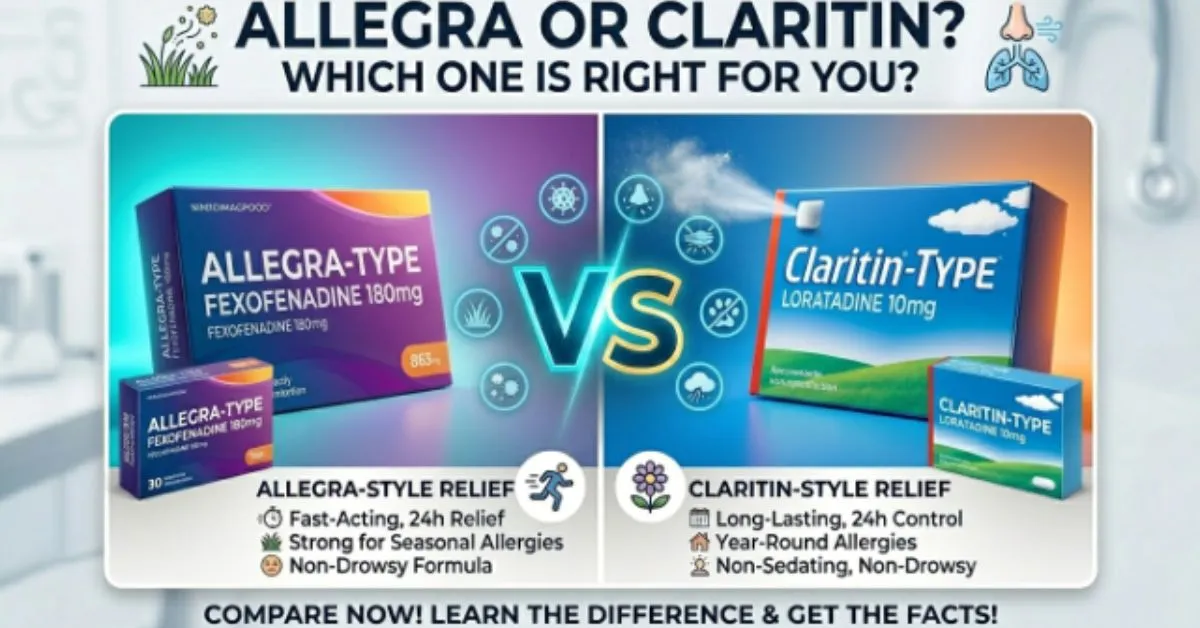
A few years ago, I walked into a pharmacy with itchy eyes, a runny nose, and nonstop sneezing. Spring allergies had hit me hard. I stood in front of the allergy medicine aisle and saw two popular options: Allegra and Claritin.
At first, I thought they were basically the same thing. These claimed to provide allergy relief. Both were non-drowsy antihistamines. Both were recommended by people I knew.
So I picked one without thinking much about it.
A few days later, I wondered if I had chosen the best option. Was Allegra better than Claritin? Did one work faster? Was one stronger for seasonal allergies? The more I searched, the more confused I became.
If you’ve ever found yourself comparing Allegra or Claritin, you’re not alone. Many people search this keyword because they want quick allergy relief without wasting money or choosing the wrong medication.
The good news is that both medicines can help with common allergy symptoms. However, there are important differences that may make one a better choice for your situation.
In this guide, you’ll learn exactly how Allegra and Claritin compare, their benefits, possible side effects, and which option may work best for your allergy needs.
✅ Allegra or Claritin – Quick Answer
Allegra and Claritin are both non-drowsy antihistamines used to treat allergy symptoms such as sneezing, runny nose, itchy eyes, and itching.
Examples:
- Allegra may work faster for some people.
- Claritin is often chosen for mild seasonal allergies.
- Both are available over the counter.
Neither medicine is universally better. The best choice depends on your symptoms, lifestyle, and how your body responds.
📖 What Does Allegra or Claritin Mean?
Allegra and Claritin are allergy medications designed to block histamine.
Histamine is a chemical your body releases when it reacts to allergens like pollen, dust, mold, or pet dander.
What Is Allegra?
Allegra contains the active ingredient fexofenadine.
It is a second-generation antihistamine that helps relieve:
- Sneezing
- Runny nose
- Itchy eyes
- Itchy throat
- Hives
Many people choose Allegra because it is less likely to cause drowsiness.
What Is Claritin?
Claritin contains the active ingredient loratadine.
Like Allegra, it is also a second-generation antihistamine.
It helps relieve:
- Seasonal allergies
- Indoor allergies
- Sneezing
- Runny nose
- Itchy eyes
Claritin is known for its once-daily convenience and long-lasting relief.
Examples
- A person with pollen allergies may use Allegra during spring.
- Someone with pet allergies may choose Claritin for daily symptom control.
- Both medicines can help reduce itchy eyes and sneezing.
🧠 Why Do People Confuse Allegra or Claritin?
People often confuse these medications because they serve nearly the same purpose.
Some reasons include:
- Both treat allergy symptoms.
- Both are available without a prescription.
- Both are considered non-drowsy.
- Both are taken once daily in many cases.
The packaging and marketing can also make them seem identical.
Since they belong to the same drug category, many shoppers assume there is no difference between them. However, factors such as onset time, side effects, and individual response can vary.
⚖️ Allegra vs Claritin
| Feature | Allegra | Claritin |
| Active Ingredient | Fexofenadine | Loratadine |
| Drug Type | Antihistamine | Antihistamine |
| Drowsiness Risk | Very low | Low |
| Duration | Up to 24 hours | Up to 24 hours |
| Common Use | Seasonal allergies | Seasonal and indoor allergies |
| Available OTC | Yes | Yes |
| Once Daily Option | Yes | Yes |
| Generic Available | Yes | Yes |
Key Difference
Allegra is often preferred by people who want the lowest possible risk of drowsiness.
Claritin is commonly chosen because it is widely available and works well for everyday allergy control.
American vs British Usage
Unlike spelling-based comparisons, Allegra and Claritin are brand names.
However, availability and brand recognition can vary between regions.
| Region | Popular Option |
| United States | Allegra and Claritin |
| United Kingdom | Generic antihistamines often preferred |
| Canada | Both commonly available |
| Global Market | Claritin often has wider recognition |
Globally, both medications are trusted allergy treatments and are commonly recommended by healthcare professionals.
💬 Real-Life Examples of Allegra or Claritin
In an Email
“I’ve been dealing with seasonal allergies and am trying to decide between Allegra or Claritin.”
On Social Media
“My allergies are terrible this week. Has anyone had better results with Allegra or Claritin?”
In the Workplace
“I started taking Claritin for my allergies, and my symptoms have improved.”
In Daily Conversation
“I’m not sure whether Allegra or Claritin would work better for my pollen allergies.”
⚠️ Common Mistakes to Avoid
1. Thinking One Works for Everyone
❌ Wrong: Allegra is always better.
✅ Correct: Different people respond differently.
2. Taking More Than Recommended
❌ Wrong: Extra tablets work faster.
✅ Correct: Follow label instructions carefully.
3. Ignoring Food Interactions
❌ Wrong: Any drink is fine with medication.
✅ Correct: Some fruit juices may affect Allegra absorption.
4. Expecting Instant Results
❌ Wrong: Allergy symptoms disappear immediately.
✅ Correct: Relief may take time.
5. Using Allergy Medicine for Every Symptom
❌ Wrong: Antihistamines treat all respiratory problems.
✅ Correct: Some symptoms may require different treatment.
🎯 Pro Tips to Remember Allegra or Claritin
Tip 1
Think of both medicines as allergy fighters.
Tip 2
Remember that Allegra contains fexofenadine.
Tip 3
Remember that Claritin contains loratadine.
Tip 4
If avoiding drowsiness is your top priority, Allegra is often considered a strong option.
Tip 5
Always follow package directions and consult a healthcare professional when needed.
📊 Usage Trends & Popularity
Both Allegra and Claritin remain among the most popular over-the-counter allergy medications.
Recent trends show:
- Seasonal allergy searches increase every spring.
- Claritin has strong brand recognition worldwide.
- Allegra is often searched by people looking for non-drowsy relief.
- These medicines are widely used in the United States.
As allergy seasons become longer in some regions, interest in antihistamines continues to grow.
❓ FAQs
1. Is Allegra stronger than Claritin?
Not necessarily. Effectiveness varies from person to person.
2. Can I take Allegra and Claritin together?
You should only combine medications if advised by a healthcare professional.
3. Which medicine causes less drowsiness?
Allegra is often considered less likely to cause drowsiness.
4. Do both medicines treat hay fever?
Yes. Both are commonly used for seasonal allergies.
5. Can children use Allegra or Claritin?
Certain versions are approved for children, but dosing depends on age.
6. How long do they last?
Both commonly provide relief for up to 24 hours.
7. Are generic versions available?
Yes. Generic forms are widely available.
8. Do they help itchy eyes?
Yes. Both medicines can help relieve itchy eyes caused by allergies.
9. Which is more popular?
Both are popular, but Claritin generally has stronger global brand recognition.
Conclusion
Choosing between Allegra or Claritin can feel confusing because both medicines are designed to treat many of the same allergy symptoms. They help reduce sneezing, runny noses, itchy eyes, and other common reactions caused by allergens.
The main difference is that Allegra contains fexofenadine, while Claritin contains loratadine. Although they belong to the same drug class, individual experiences can vary. One person may find Allegra works better, while another may get greater relief from Claritin.
For many people, the decision comes down to personal preference, symptom severity, and how their body responds. As both medications are widely trusted and available over the counter, either can be an effective choice for managing allergies.
The best takeaway is simple: if one option doesn’t provide the relief you need, speak with a healthcare professional about alternatives. Finding the right allergy medication can make a huge difference in your comfort and quality of life.

I’m Mark Twain, a grammar expert and the founder of Grammariffy.com. I help readers master English grammar, spelling, and word usage through simple, easy-to-understand guides.