I still remember the panic I felt when I noticed tiny white specks in my hair while getting ready for work. At first, I thought it was just dandruff. After all, dandruff is common, and I had dealt with it before.
But then I noticed something strange. The white particles weren’t falling off easily. No matter how much I brushed my hair, some of them stayed attached. That’s when I started wondering if it was something more serious.
A quick online search introduced me to two terms: nits and dandruff.
At first glance, they look very similar. Both appear as small white flakes or specks in the hair. Both can make your scalp look unhealthy. And both can cause embarrassment, especially in social situations.
However, nits and dandruff are completely different conditions. One is related to head lice, while the other is a scalp condition caused by skin shedding.
Many people search for “nits or dandruff” because they want to know what those white flakes in their hair really mean. Understanding the difference can help you choose the right treatment and avoid unnecessary stress.
In this guide, you’ll learn how to identify nits and dandruff, understand their causes, and discover the easiest ways to tell them apart.
✅ Nits or Dandruff – Quick Answer
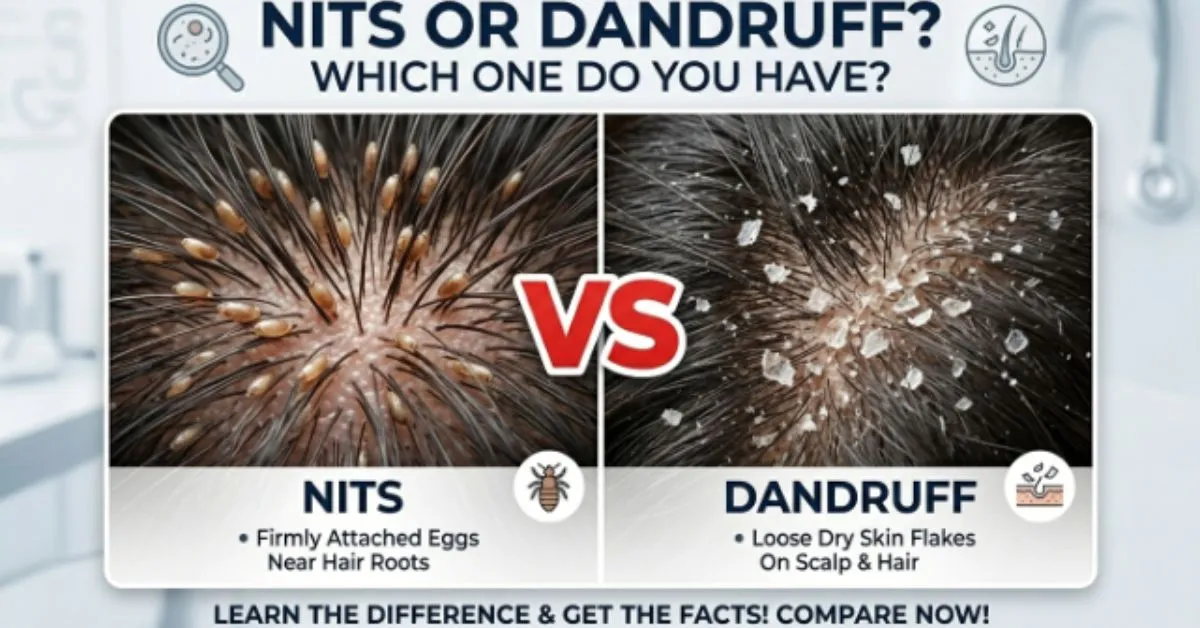
Nits are lice eggs that stick firmly to hair strands, while dandruff consists of loose flakes of dead skin that fall from the scalp.
Examples:
- If the white specks easily fall off, it is likely dandruff.
- If the specks stay attached to the hair, they may be nits.
- Nits usually indicate a head lice infestation, while dandruff does not.
The biggest difference is that nits are firmly glued to hair shafts, while dandruff flakes are loose and easy to remove.
📖 What Does Nits or Dandruff Mean?
What Are Nits?
Nits are tiny eggs laid by head lice.
They are usually:
- White, yellow, or tan
- Oval-shaped
- Attached to individual hair strands
- Found close to the scalp
Female lice glue these eggs to the hair shaft, making them difficult to remove.
What Is Dandruff?
Dandruff is a common scalp condition that causes dead skin cells to shed.
Common signs include:
- White flakes on hair and clothing
- Dry or oily scalp
- Mild itching
- Flakes that fall easily
Unlike nits, dandruff is not caused by insects.
Examples
- A child returning from school with lice may have nits.
- A person with a dry scalp may develop dandruff.
- White flakes on a black shirt are often caused by dandruff.
🧠 Why Do People Confuse Nits or Dandruff?
People confuse nits and dandruff because both appear as tiny white particles in the hair.
Common reasons include:
- Both can cause scalp itching.
- Both are visible near the scalp.
- Both appear white or light-colored.
- Both are commonly seen in children and adults.
Most people notice the white specks before examining them closely. Since they look similar from a distance, confusion is very common.
Another reason is that many people are unfamiliar with what lice eggs actually look like.
⚖️ Nits vs Dandruff
| Feature | Nits | Dandruff |
| Cause | Head lice eggs | Dead skin flakes |
| Appearance | Oval-shaped | Irregular flakes |
| Attached to Hair | Yes | No |
| Easy to Remove | Difficult | Easy |
| Itching | Common | Common |
| Contagious | Yes (lice spread) | No |
| Treatment | Lice treatment | Anti-dandruff products |
| Location | Hair shafts | Scalp and hair |
Understanding the Difference
A simple way to remember:
- Nits stick.
- Dandruff flakes fall.
If you can easily brush it away, it is more likely dandruff.
American vs British Usage
The terms “nits” and “dandruff” are commonly used in both American and British English.
| Term | American English | British English |
| Nits | Common | Common |
| Dandruff | Common | Common |
There is no significant spelling difference between the USA and the UK.
Globally, both terms are widely understood.
💬 Real-Life Examples of Nits or Dandruff
In an Email
“My child has white particles in their hair, and I’m trying to determine whether they are nits or dandruff.”
On Social Media
“I thought I had dandruff, but it turned out to be nits.”
In the Workplace
“My scalp has been itchy lately, and I’m checking whether it’s dandruff.”
In Daily Conversation
“These white flakes keep appearing in my hair. Could they be nits or dandruff?”
⚠️ Common Mistakes to Avoid
1. Assuming All White Flakes Are Dandruff
❌ Wrong: Every white speck is dandruff.
✅ Correct: Some white specks may be nits.
2. Ignoring Persistent Itching
❌ Wrong: Itching is always caused by dry skin.
✅ Correct: Lice infestations can also cause itching.
3. Using Dandruff Shampoo for Nits
❌ Wrong: Anti-dandruff shampoo kills lice eggs.
✅ Correct: Special lice treatments are needed.
4. Not Checking Hair Closely
❌ Wrong: A quick glance is enough.
✅ Correct: Examine the hair shaft carefully.
5. Delaying Treatment
❌ Wrong: The problem will disappear on its own.
✅ Correct: Early treatment can prevent complications.
🎯 Pro Tips to Remember Nits or Dandruff
Tip 1
Remember: nits are eggs, dandruff is skin.
Tip 2
Try gently shaking your hair.
If the flakes fall, they are likely dandruff.
Tip 3
Use a fine-tooth comb to inspect hair strands.
Tip 4
Check behind the ears and near the neck, where nits often appear.
Tip 5
Look for movement. Live lice may indicate nits are present.
📊 Usage Trends & Popularity
Searches for “nits or dandruff” increase throughout the school year because lice outbreaks are common among children.
Current trends show:
- Dandruff affects millions of people worldwide.
- Head lice remain a common concern in schools.
- Parents frequently search for ways to identify nits.
- Social media discussions often focus on scalp health and lice prevention.
Globally, dandruff is more common than head lice infestations, but both remain popular search topics.
❓ FAQs
1. How can I tell if it’s nits or dandruff?
Nits stay attached to hair strands, while dandruff flakes fall off easily.
2. Are nits contagious?
Nits themselves do not move, but they indicate a lice infestation that can spread.
3. Does dandruff spread from person to person?
No. Dandruff is not contagious.
4. Can adults get nits?
Yes. Although more common in children, adults can also get head lice.
5. Do nits cause itching?
Yes. Many people experience scalp itching with lice infestations.
6. Can dandruff cause itching?
Yes. Dandruff often causes mild to moderate itching.
7. What color are nits?
Nits may appear white, yellow, tan, or light brown.
8. Can dandruff look like lice eggs?
Yes. This is one of the main reasons people confuse the two.
9. Should I see a doctor?
If you’re unsure whether you have nits or dandruff, a healthcare professional can help identify the cause.
Conclusion
The confusion between nits or dandruff is extremely common because both conditions create small white particles in the hair. However, once you understand the key differences, identifying them becomes much easier.
Nits are lice eggs that stick tightly to hair shafts and usually indicate a head lice infestation. Dandruff, on the other hand, consists of loose flakes of dead skin that fall away easily and are not contagious.
The simplest test is to check whether the particles can be brushed off. If they remain firmly attached, they may be nits. If they fall away without much effort, they are more likely dandruff.
Knowing the difference helps you choose the right treatment and avoid unnecessary worry. Whether you’re dealing with lice or a flaky scalp, early action can make the problem much easier to manage.

I’m Mark Twain, a grammar expert and the founder of Grammariffy.com. I help readers master English grammar, spelling, and word usage through simple, easy-to-understand guides.