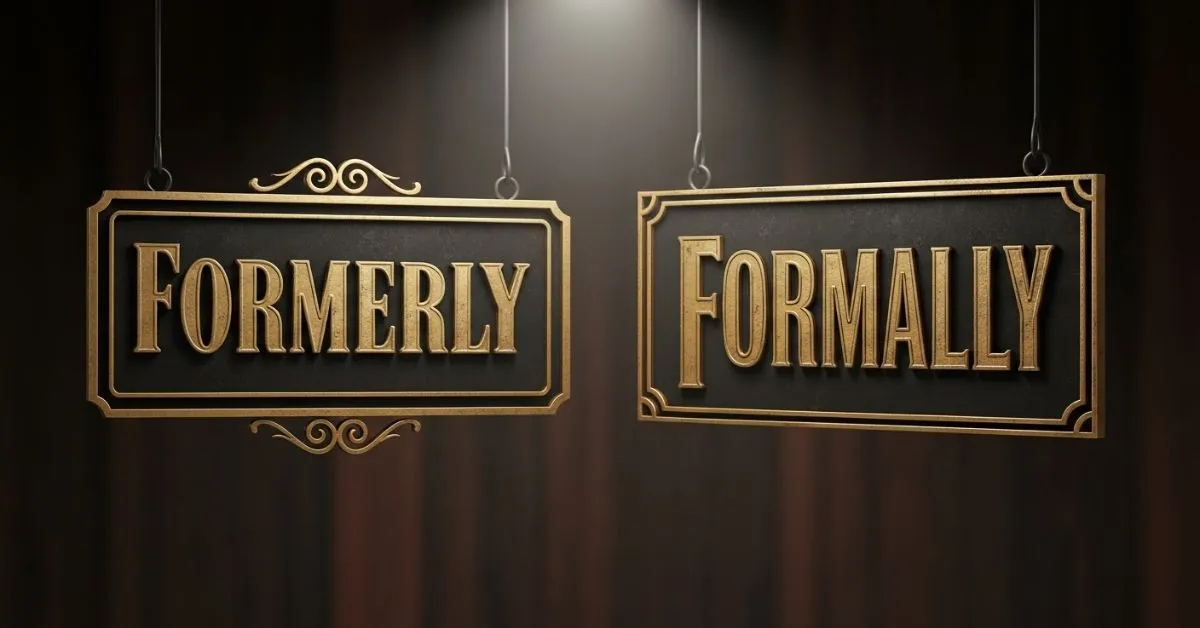
I still remember the moment clearly. I was writing a quick email and typed, “I am formally known as…” Then I paused. Something didn’t feel right. I stared at the sentence for a few seconds and thought, wait… is it formally or formerly?
If you’ve ever had this same confusion, trust me you’re not alone. I’ve been there too, second-guessing a simple word and worrying if it might change the whole meaning of my sentence.
So I did what most of us do I checked, learned the difference, and fixed it. That’s when I realized something important: formerly and formally may look similar, but they mean completely different things. One talks about the past, and the other is about being proper or official.
After that, I made a simple rule for myself, and honestly, I’ve never mixed them up again. In this guide, I’ll share that same easy trick with you so you can feel confident every time you use these words.
⚡Formerly or Formally – Quick Answer
- Formerly = in the past
- Formally = in a proper, official, or polite way
Examples:
- She was formerly a teacher. ✅ (past role)
- He spoke formally at the meeting. ✅ (proper tone)
❌ Wrong: She was formally a teacher.
✔ Correct: She was formerly a teacher.
📜 The Origin of Formerly or Formally
Understanding the roots makes this easier:
- Formerly comes from the word former, meaning “earlier” or “before.”
- Formally comes from formal, meaning “official,” “structured,” or “polite.”
So:
- Formerly = time (past)
- Formally = behavior/style (proper)
That’s why they are often confused they look alike but come from different meanings.
🌍 British English vs American English Spelling
Good news:
There is no spelling difference between British and American English for these words.
| Word | British English | American English | Meaning |
| Formerly | Formerly | Formerly | In the past |
| Formally | Formally | Formally | In a proper/official way |
Unlike words like colour/color, these stay the same everywhere.
🧭 Which Spelling Should You Use?
It depends on your meaning, not your audience:
- 🇺🇸 US audience → Same rule
- 🇬🇧 UK/Commonwealth → Same rule
- 🌍 Global writing → Same rule
Simple tip:
- Talking about past → use formerly
- Talking about manners or official tone → use formally
❌Common Mistakes with Formerly or Formally
Here are mistakes people often make:
❌ “The company was formally known as ABC.”
✔ “The company was formerly known as ABC.”
❌ “Please dress formerly for the event.”
✔ “Please dress formally for the event.”
❌ “He formerly greeted the guests.”
✔ “He formally greeted the guests.”
Easy trick:
- Formerly = Former (past)
- Formally = Formal (proper)
📝 Formerly or Formally in Everyday Examples
📧 Emails
- I formerly worked at that company.
- Please respond formally to the client.
📰 News
- The brand was formerly called something else.
- The president formally announced the decision.
💬 Social Media
- This place was formerly a cafe.
- She was formally invited to the event.
🧾 Formal Writing
- The building was formerly a school.
- The agreement was formally signed.
📊 Formerly or Formally – Google Trends & Usage Data
- Formerly is often searched in business and history contexts
(e.g., “formerly known as”) - Formally is popular in professional and academic writing
(e.g., “formally introduce,” “formally request”)
Usage by region:
- 🇺🇸 US → both used equally in writing
- 🇬🇧 UK → same pattern
- 🌏 Global → confusion is common everywhere
📋 Comparison Table: Formerly vs Formally
| Feature | Formerly | Formally |
| Meaning | In the past | In a proper/official way |
| Root word | Former | Formal |
| Usage type | Time-related | Style/behavior-related |
| Example | Formerly a manager | Formally dressed |
| Common phrase | Formerly known as | Formally invited |
FAQs❓
1. What is the main difference between formerly and formally?
Formerly means in the past. Formally means in a proper or official way.
2. Can formerly and formally be used interchangeably?
No. They have completely different meanings.
3. Is “formerly known as” correct?
Yes. This is a very common and correct phrase.
4. What does formally mean in writing?
It means using a polite, structured, or professional tone.
5. Why do people confuse these words?
They look and sound similar but have different meanings.
6. Is there a spelling difference in UK and US English?
No. Both words are spelled the same everywhere.
7. How can I remember the difference easily?
- Formerly = Former (past)
- Formally = Formal (proper)
Conclusion
It’s easy to mix up formerly and formally, but once you see the difference, it becomes simple. I used to confuse them too, especially in emails and formal writing. But the moment I linked formerly with “former” (past) and formally with “formal” (proper), everything clicked.
The key is to focus on meaning, not spelling. If you’re talking about something that happened before, use formerly. If you’re describing behavior, tone, or an official action, use formally. This small change can make your writing clearer and more professional.
In daily use whether you’re writing emails, posts, or articles choosing the right word shows attention to detail. And that always leaves a better impression.
Discover More Articles:
- Pneumonic or Mnemonic : Explained (Simple & Clear)🧠(2026)
- Lies or Lays : Avoid This Common Grammar Mistake🛏️(2026)
- Lead or Leed : Explained (With Easy Examples)✍️(2026)

“I’m Bill Bryson, a grammar expert at Grammeriffy.com. I share clear tips and guidance to help readers master English confidently.”