I remember reading a social media comment where someone wrote, “Please cum to my office tomorrow.” At first, I thought it was a joke. But after looking closer, I realized the writer genuinely meant “come.” The problem was that a single spelling mistake completely changed the meaning of the sentence and made it sound awkward and embarrassing.
This confusion happens more often than people realize.
Many English learners hear the words “come” and “cum” pronounced similarly in certain situations. Because of that, they assume both spellings can be used interchangeably. Others encounter the slang term online and mistakenly think it is an acceptable substitute in formal writing.
That’s why people frequently search for “cum or come.”
The good news is that the rule is simple. One word belongs in standard English writing, while the other is mainly used as slang or in specialized contexts.
In this guide, you’ll learn the difference between cum and come, when to use each word, common mistakes, practical examples, and easy memory tricks to help you avoid embarrassing errors.
✅ Cum or Come – Quick Answer
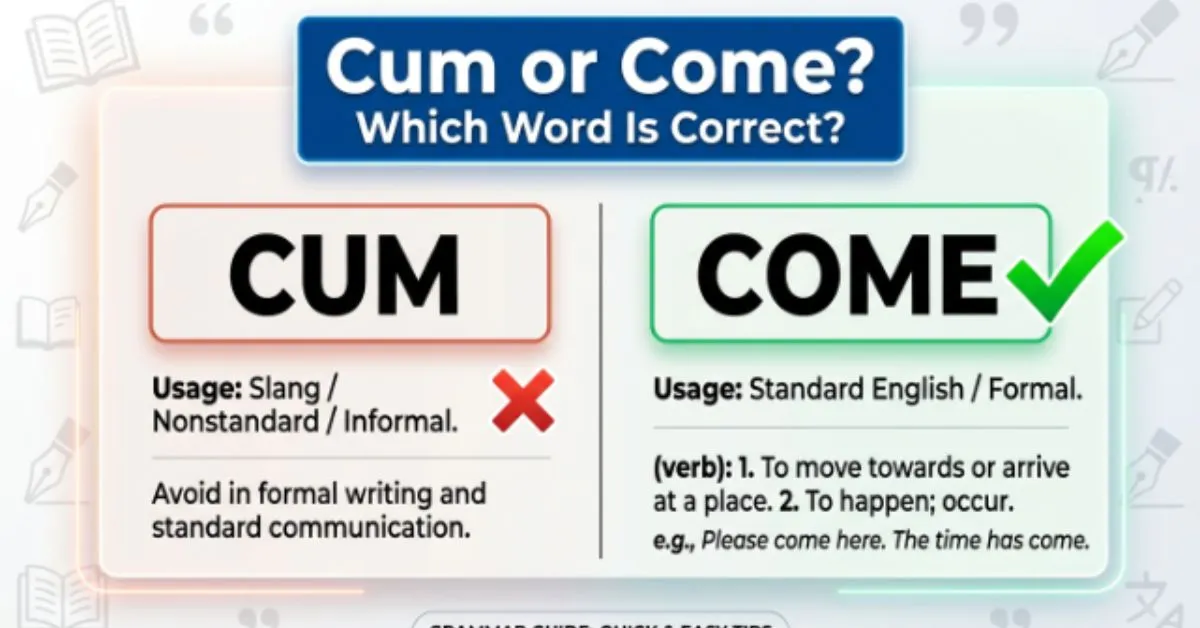
Come is the correct standard English word meaning to move toward someone, arrive, or happen.
Cum is mainly a slang term or a specialized Latin-derived word used in limited contexts.
Examples:
- Please come here.
- Can you come to the meeting tomorrow?
- She will come home later.
In everyday English writing, come is usually the correct choice.
📖 What Does Cum or Come Mean?
What Is Come?
Come is a common English verb.
It means:
- To move toward a place
- To arrive
- To happen
- To reach a destination
Examples:
- Please come inside.
- They will come tomorrow.
- The package has come already.
Come is one of the most frequently used verbs in English.
What Is Cum?
Cum has two primary uses.
1. Informal Slang
In slang, cum is used in sexual contexts.
2. Latin-Derived Usage
In some formal expressions, cum means “combined with” or “together with.”
Examples:
- Bedroom-cum-office
- Restaurant-cum-café
- Studio-cum-workspace
This usage is mostly seen in British English and formal writing.
🧠 Why Do People Confuse Cum or Come?
1. Similar Pronunciation
The words can sound similar when spoken quickly.
2. Internet Slang
Many people first encounter “cum” online.
3. English Learning Challenges
Learners often spell words based on sound.
4. Informal Messaging
Text messages sometimes encourage incorrect spellings.
5. Lack of Context
Without context, writers may not realize the meanings are different.
⚖️ Cum vs Come
| Feature | Cum | Come |
| Standard English Verb | No | Yes |
| Meaning | Slang or “combined with” | Arrive or move toward |
| Formal Writing | Rare | Common |
| Everyday Use | Limited | Very common |
| Business Writing | Rare | Common |
| Academic Writing | Rare | Common |
Main Difference
Come is the standard English verb.
Cum is a specialized or slang term with completely different meanings.
American vs British Usage
Come
Used everywhere in English-speaking countries.
Cum
More likely to appear in British English expressions such as:
- Kitchen-cum-dining room
- Shop-cum-café
| Region | Come | Cum |
| USA | Very common | Rare |
| UK | Very common | Occasionally used |
| Canada | Very common | Rare |
| Australia | Very common | Occasionally used |
Which Is More Common Globally?
Come is overwhelmingly more common.
💬 Real-Life Examples of Cum or Come
Emails
“Please come to the meeting at 10 AM.”
Workplace
“The manager will come later.”
Social Media
“Come join us for the event!”
Daily Conversation
“Can you come with me?”
British Formal Usage
“The building serves as a library-cum-community center.”
⚠️ Common Mistakes to Avoid
1. Using Cum Instead of Come
❌ Please cum to my office.
✅ Please come to my office.
2. Using Slang in Professional Writing
❌ Cum to the conference room.
✅ Come to the conference room.
3. Assuming Both Spellings Mean The Same Thing
❌ Cum and come are interchangeable.
✅ They have different meanings.
4. Copying Internet Slang
❌ Cum over tomorrow.
✅ Come over tomorrow.
5. Ignoring Context
❌ Use cum in all situations.
✅ Use come for standard English communication.
🎯 Pro Tips to Remember Cum or Come
Tip 1
Think of “come” as the everyday word.
Tip 2
If you’re talking about arriving somewhere, use come.
Tip 3
Professional writing almost always requires come.
Tip 4
Remember that come appears in dictionaries as a common verb.
Tip 5
When unsure, choose come.
📊 Usage Trends & Popularity
Come
Used in:
- Schools
- Workplaces
- Books
- News articles
- Everyday conversations
Cum
Used in:
- Slang contexts
- Certain British compound expressions
- Limited formal constructions
Which Is More Popular?
Come is vastly more common in global English usage.
Most English speakers use it every day.
❓ FAQs
1. Is come the correct spelling?
Yes. Come is the standard English verb.
2. Is cum a real word?
Yes, but it has different meanings and limited usage.
3. Can I use cum instead of come?
No. In most situations, you should use come.
4. What does come mean?
It means to arrive, approach, or move toward a place.
5. What does cum mean in British English?
It can mean “combined with” in certain compound expressions.
6. Which word should I use in emails?
Use come.
7. Is cum acceptable in professional writing?
Only in specific compound expressions. Otherwise, use come.
8. Why do people confuse these words?
Because they may sound similar and appear online frequently.
9. Which spelling is more common?
Come is far more common.
Conclusion
The confusion between cum and come usually happens because the words can sound similar, but their meanings are very different.
Come is the standard English verb used to describe arriving, approaching, or moving toward someone or something. It appears in everyday conversations, emails, books, academic writing, and professional communication.
Cum, on the other hand, has specialized meanings. It may appear in certain British compound expressions or informal slang, but it is not a replacement for come in normal English writing.
For students, professionals, writers, and English learners, the safest rule is simple: if you’re talking about arriving somewhere or moving toward a location, always use come.
Understanding this difference can help you avoid embarrassing mistakes and make your writing look more polished and professional.
Remember this easy rule: when you mean arrive or approach, the correct word is always come.

“I’m Erin McKean, a grammar expert at Grammeriffy.com. I share practical tips to help readers write English clearly and confidently.”