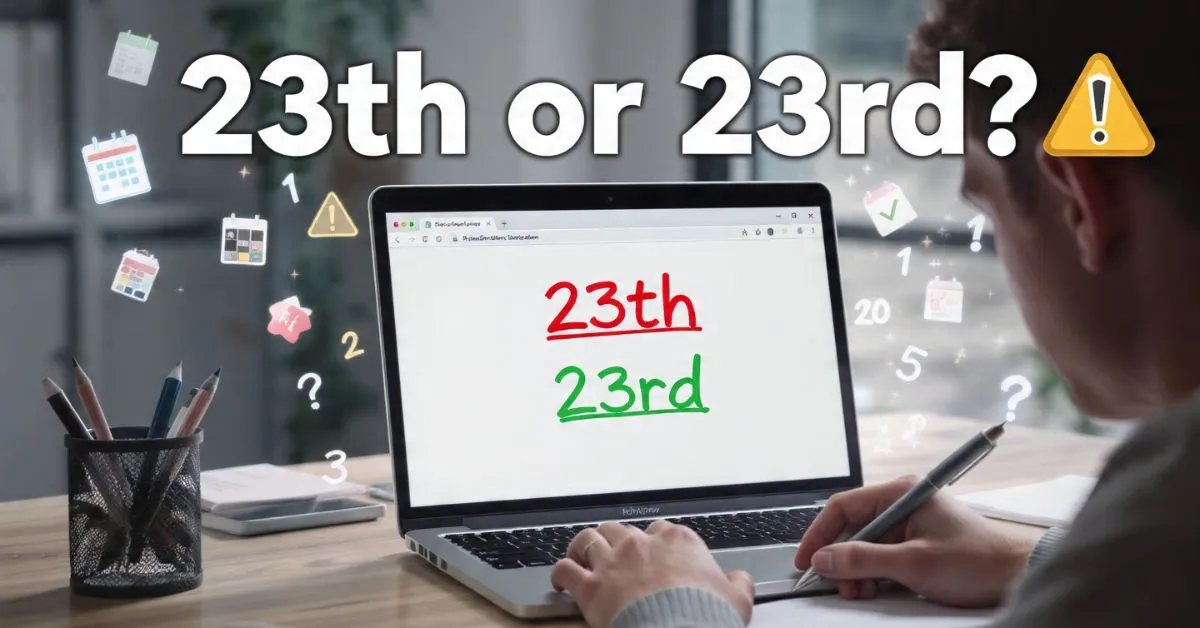
I still remember writing a date in a message and feeling completely confident about it. I typed: “23th of July.” It looked fine to me at that moment, so I moved on without thinking twice. But later, when I was reviewing my writing, I noticed something strange. My brain kept asking, “Wait… is it 23th or 23rd?” That’s when I stopped for a second because it suddenly didn’t feel right anymore.
I remember I actually went back and checked multiple times, almost doubting myself. And honestly, I felt a bit silly because it was such a small detail, but it was enough to make my sentence look wrong. That’s the moment I realized I wasn’t fully clear on how ordinal numbers work in English. I was just guessing based on how it “looked right” in my mind.
So I decided to fix it properly. I learned the simple rule, and after that, I never got confused again between 23th or 23rd or any similar dates. And if you’re here because you’ve made the same mistake, I want you to know something I’ve been in that exact situation. It’s not about being bad at English. It’s just one of those small rules that nobody really explains clearly.
Let’s make it super simple so you never get confused again 👇
✅ 23th or 23rd – Quick Answer
The correct form is 23rd ✅
23th is incorrect ❌
✔️ Examples:
- My exam is on the 23rd.
- The meeting is set for July 23rd.
- She was born on the 23rd of May.
👉 Simple rule:
If a number ends in 3, use “rd” (except 13).
📖 The Origin of 23th or 23rd
To understand 23th or 23rd, we need to look at ordinal numbers. These are numbers that show position, like first, second, and third.
In old English:
- 1 → first (1st)
- 2 → second (2nd)
- 3 → third (3rd)
Over time, these words became short forms:
- st, nd, rd, th
So when we say 23, we look at the last digit:
- 23 ends in 3
- So it follows the rule → 23rd
👉 Why do people write “23th”?
Because most numbers use “th” (like 4th, 5th, 6th). People think the same rule works for all numbers but it doesn’t.
👉 Important exception:
- 11, 12, 13 → always use th
- So: 13th (not 13rd)
British vs American Usage
Good news! There is no difference between British and American English for 23th or 23rd.
| Usage Type | Correct Form |
| American English | 23rd ✅ |
| British English | 23rd ✅ |
| Incorrect Form | 23th ❌ |
✔️ Examples:
- 🇺🇸 US: The event is on the 23rd.
- 🇬🇧 UK: The event is on the 23rd.
👉 Both follow the same rule. No confusion here.
🎯 Which One Should You Use?
Always use 23rd. There is no situation where 23th is correct.
Here’s a simple guide:
- 🇺🇸 US audience → 23rd
- 🇬🇧 UK audience → 23rd
- 🌍 Global audience → 23rd
👉 Easy tip:
Look at the last number:
- Ends in 1 → st
- Ends in 2 → nd
- Ends in 3 → rd
- Everything else → th
⚠️ Remember:
- 11, 12, 13 → always “th”
⚠️ Common Mistakes with 23th or 23rd
Here are mistakes people often make:
❌ Wrong:
- 23th
- 3th
- 13rd
✅ Correct:
- 23rd
- 3rd
- 13th
👉 Another common issue:
People mix formats in the same text.
❌ “The event is on 23th and ends on 24rd.”
✅ “The event is on 23rd and ends on 24th.”
👉 Tip:
Always check the last digit before writing the ending.
💬 23th or 23rd in Real-Life Examples
Here’s how 23rd is used in daily life:
📧 Email:
The meeting is scheduled for the 23rd. Please confirm.
📱 Social Media:
Party on the 23rd! 🎉 Don’t miss it.
📰 Professional Writing:
The contract begins on the 23rd of August.
🗣️ Casual Conversation:
“Let’s meet on the 23rd.”
👉 You’ll notice one thing:
No one uses “23th” in correct writing.
📊 Usage Trends & Popularity
When people search “23th or 23rd”, they are usually confused about ordinal rules.
📈 Trends show:
- 23rd → very high usage worldwide
- 23th → very low usage (mistake)
🌎 Popular in:
- United States
- United Kingdom
- Canada
- Australia
👉 Why is “23rd” more popular?
Because it follows correct grammar rules. Search engines and tools like spell check always prefer 23rd and often auto-correct 23th.
👉 Insight:
Most “23th” searches come from learners trying to confirm the correct form.
📋 Comparison Table (Keyword Variations)
| Word/Form | Correct? | Usage |
| 23rd | ✅ Correct | Proper ordinal form |
| 23th | ❌ Incorrect | Common mistake |
| 23 | ✅ Correct | Cardinal number (no order) |
| 3rd | ✅ Correct | Base rule example |
FAQs❓
1. Is 23th ever correct?
No. 23th is always wrong. The correct form is 23rd.
2. Why do we use “rd” in 23rd?
Because the number ends in 3, and numbers ending in 3 take “rd.”
3. What about 13? Is it 13rd?
No. It is 13th. Numbers 11–13 are exceptions.
4. Do US and UK English differ here?
No. Both use 23rd only.
5. Can I just write 23 instead of 23rd?
Yes, in some formats like dates (June 23). But in sentences, use 23rd.
6. What are similar examples?
3rd, 33rd, 43rd all follow the same rule.
7. Why do people write 23th?
Because they think all numbers use “th.” It’s a common misunderstanding.
8. How can I remember the rule easily?
Think: 3 → rd → 23rd. Simple and quick.
Conclusion
The confusion between 23th or 23rd is very common, but the answer is simple. The correct form is always 23rd. The version 23th is just a mistake.
This happens because English ordinal numbers don’t follow one single rule. While many numbers use “th,” numbers ending in 1, 2, and 3 use “st,” “nd,” and “rd.” That’s where people get confused. But once you understand this pattern, it becomes easy.
There is no difference between British and American English, which makes things even simpler. No matter where your audience is, 23rd is always the correct choice.
Using the wrong form like 23th may seem small, but it can affect how your writing looks. It can make emails, assignments, or professional content seem less polished. The good news is that this mistake is easy to fix.
Just remember one simple rule:
If the number ends in 3, use rd except for 13.
So next time you write a date, you won’t hesitate. You’ll confidently write 23rd clear, correct, and professional.
Discover More Articles:
- Develope or Develop : Quick Guide for Perfect Spelling✍️(2026)
- Nineth or Ninth : The Correct Spelling Explained Simply🔢(2026)
- Utube or YouTube : Stop Making This Common Mistake📱(2026)

“I’m Erin McKean, a grammar expert at Grammeriffy.com. I share practical tips to help readers write English clearly and confidently.”