I remember writing a quick email: “I openned the file you sent.” I paused right after hitting space. Something didn’t look right. Was it openned or opened? I had seen people make this mistake before, and now I wasn’t sure myself.
If you’ve searched “openned or opened,” you’re not alone. Many people get confused when adding -ed to verbs. Some words double the last letter, while others don’t and that’s where mistakes happen.
The confusion usually comes from English spelling rules. Words like plan → planned double the “n,” so it’s easy to think open should become openned. But English doesn’t always follow one simple pattern.
In this guide, I’ll explain the correct spelling, why this confusion happens, and how to avoid this mistake in your writing.
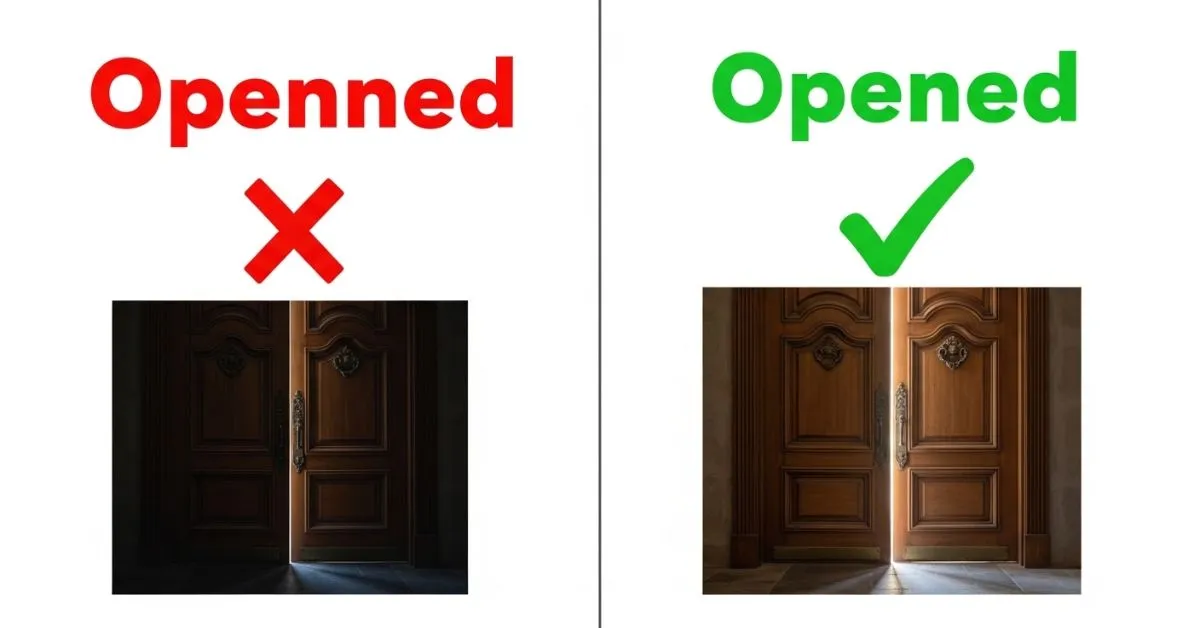
✅ Openned or Opened – Quick Answer
The correct spelling is opened ✅
Openned is incorrect ❌
✔️ Examples:
- I opened the door.
- She opened the email.
👉 Rule:
Do not double the “n” in open when adding -ed.
📚 The Origin of Openned or Opened
The word open comes from Old English openian, meaning “to make open.”
When forming the past tense:
- open → opened
👉 Why not openned?
Because “open” has two syllables (o-pen) and the stress is on the first syllable. In such cases, we usually do not double the final consonant.
🇬🇧 🇺🇸 British English vs American English Spelling
There is no difference between British and American English.
| Version | Correct Spelling |
| American English | opened |
| British English | opened |
| Incorrect Form | openned ❌ |
✔️ Examples:
- US: He opened the store early.
- UK: She opened the window.
👉 Both use opened only.
🎯 Which Spelling Should You Use?
Always use opened, no matter your audience.
- 🇺🇸 US → opened
- 🇬🇧 UK → opened
- 🌍 Global → opened
❌ Avoid openned in all writing. It is incorrect.
⚠️ Common Mistakes with Openned or Opened
Here are frequent errors:
| Mistake | Correction |
| openned | opened ✅ |
| openning | opening ✅ |
| openend | opened ✅ |
👉 Tip:
Do not double letters unless the stress is on the last syllable.
✍️ Openned or Opened in Everyday Examples
Here’s how opened is used:
📧 Email:
- I opened your attachment.
📰 News:
- The new mall opened last week.
📱 Social Media:
- Just opened my birthday gift!
📄 Formal Writing:
- The researcher opened the session with a speech.
📊 Openned or Opened – Google Trends & Usage Data
- Opened → Very high usage worldwide
- Openned → Very low usage (spelling mistake)
🌎 Popular in:
- United States
- United Kingdom
- India
- Pakistan
👉 Insight:
Search engines strongly prefer opened and often auto-correct openned.
📋 Comparison Table (Keyword Variations)
| Word | Correct? | Usage |
| opened | ✅ Correct | Past tense of open |
| openned | ❌ Incorrect | Common mistake |
| opening | ✅ Correct | Present participle |
FAQs ❓
1. Is openned ever correct?
No, openned is always incorrect.
2. What is the correct past tense of open?
The correct form is opened.
3. Why don’t we double the “n”?
Because the stress is not on the last syllable.
4. Is opened used in both US and UK English?
Yes, both use opened.
5. What is the present form?
The base form is open.
6. Is openning correct?
No, the correct spelling is opening.
7. How can I remember the rule?
Think: open → opened (no double “n”).
Conclusion
The confusion between openned and opened is very common, but the correct answer is simple. The correct spelling is always opened, without doubling the “n.” The form openned is just a mistake caused by misunderstanding spelling rules.
English verbs sometimes double letters, but only when the stress is on the final syllable. Since open is stressed on the first syllable, we do not double the “n.” This makes opened the only correct past tense form.
There is no difference between British and American English, so you can confidently use opened everywhere. Whether you are writing emails, essays, or social media posts, this is the correct choice.
Once you remember this simple rule, you won’t make this mistake again. Keep it simple: open → opened.
Discover More Articles:
- Flare or Flair : Meaning, Examples & Easy Rule✨(2026)
- Were or We’re : Clear Examples That Make It Simple📚(2026)
- Lays or Lies : Here’s the Correct Answer✍️(2026)

“I’m George Orwell, a grammar expert at Grammeriffy.com. I help readers improve their English with clear and reliable writing guidance.”