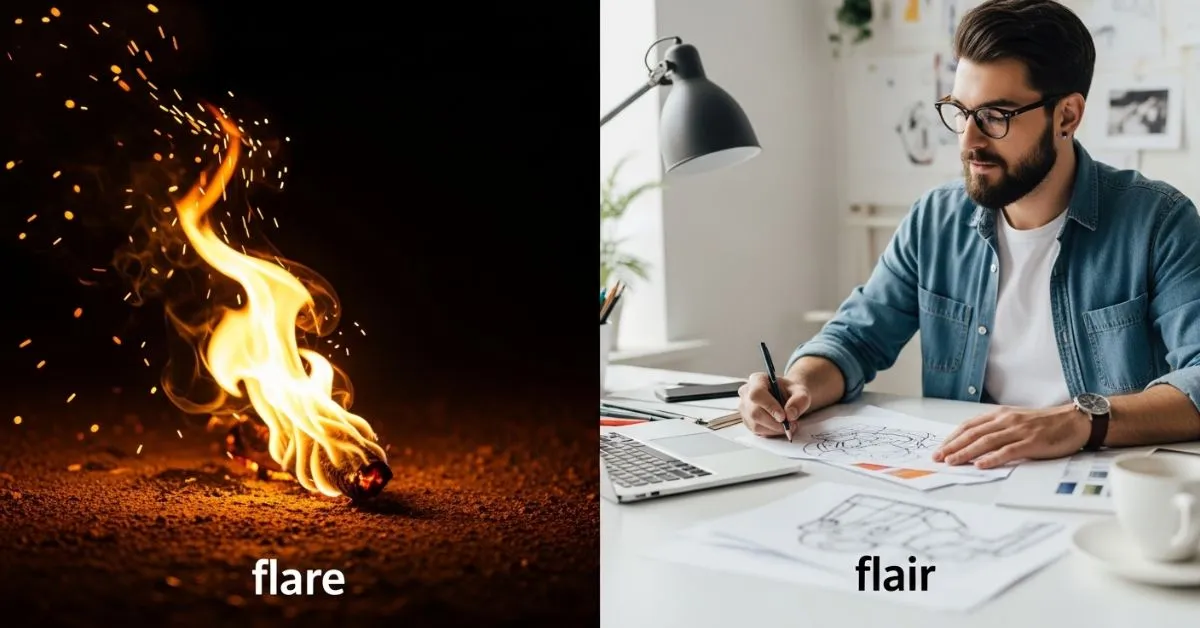
I remember writing a caption once: “She has a natural flare for design.” I paused. Something didn’t feel right. Was it flare or flair? I had seen both words before, and honestly, they looked so similar that I wasn’t sure anymore.
If you’ve ever had this moment, you’re not alone. I’ve been there too staring at the screen, second-guessing a simple word. The problem is, flare and flair sound the same, but they mean completely different things. That’s what makes them so confusing.
So I decided to fix this once and for all. I looked up the meanings, checked real examples, and practiced using them correctly. And once I understood the difference, it became super easy.
In this guide, I’ll show you exactly what I learned so you never mix up flare and flair again.
Flare or Flair – Quick Answer
- Flare → A burst of light, fire, or emotion
- Flair → Natural talent or style
Examples:
- The fire flared up suddenly.
- She has a flair for writing.
👉 Simple rule:
- Think flare = fire/light
- Think flair = talent/style
The Origin of Flare or Flair
Both words come from different roots:
- Flare comes from Middle English, meaning “to burn or shine suddenly.”
- Flair comes from French, meaning “sense” or “instinct.”
Over time, their meanings stayed separate. But because they sound the same, people often confuse them.
British English vs American English Spelling
Good news: there is no spelling difference between US and UK English.
| Word | US Spelling | UK Spelling | Meaning |
| Flare | flare | flare | Light, fire, burst |
| Flair | flair | flair | Talent, style |
👉 Both words are used the same way worldwide.
Which Spelling Should You Use?
It depends on meaning not location.
- 🇺🇸 US → Use both correctly based on meaning
- 🇬🇧 UK → Same rule applies
- 🌍 Global → No difference
✔ Choose based on context:
- Fire/light → flare
- Talent/style → flair
Common Mistakes with Flare or Flair
Here are common errors:
- ❌ She has a natural flare for music
✔ She has a natural flair for music - ❌ The match flair up quickly
✔ The match flared up quickly - ❌ Mixing meanings
✔ Always match the correct context
👉 Tip:
- Flair = skill
- Flare = fire
Flare or Flair in Everyday Examples
📧 Emails
- He has a flair for creative ideas.
📰 News
- Tensions flared during the debate.
📱 Social Media
- Add some flair to your outfit 🔥
📚 Formal Writing
- The artist showed a unique flair in design.
Flare or Flair – Google Trends & Usage Data
Search patterns show:
- “Flair” → Common in writing, design, personality topics
- “Flare” → Used in news, science, and emergencies
📍 Popular regions:
- USA → both words widely used
- UK → same usage
- Global → depends on context
👉 Most searches happen because people confuse meaning, not spelling.
Comparison Table – Flare vs Flair
| Feature | Flare | Flair |
| Meaning | Fire, light, burst | Talent, style |
| Usage | Physical events | Personal ability |
| Part of speech | Noun/verb | Noun |
| Example | Fire flared up | She has flair |
| Confusion level | High | High |
FAQs
1. Is flare or flair correct?
Both are correct but have different meanings.
2. What does “flair” mean?
It means natural talent or style.
3. What does “flare” mean?
It means a sudden burst of light, fire, or emotion.
4. How can I remember the difference?
Flair = skill, Flare = fire.
5. Are flare and flair used in US and UK English?
Yes. Both are the same in US and UK.
6. Can flare mean talent?
No. That is incorrect. Use flair.
7. Why are these words confusing?
Because they sound the same but have different meanings.
Conclusion
The confusion between flare and flair is very common, but once you understand the difference, it becomes easy to use them correctly. Both words are spelled the same in American and British English, so the only thing you need to focus on is their meaning.
Flare is used for things like fire, light, or sudden emotion. On the other hand, flair is about talent, style, or natural ability. This small difference can completely change the meaning of your sentence.
Mistakes usually happen because the words sound identical, and many people rely on sound instead of meaning while writing. But now that you know the rule, you can avoid this error easily.
So next time you write, just remember: if you’re talking about skill, use flair. If it’s about fire or something bursting, use flare. This simple trick will keep your writing clear, correct, and professional every time.
Discover More Articles:
- Artefacts or Artifacts : The Truth Behind This Spelling Difference🏺(2026)
- Enrollment or Enrolment : US vs UK Spelling Made Simple🎓(2026)
- Fiber or Fibre : The Truth Behind This Spelling Difference🥗(2026)

“I’m Agatha Christie, the grammar expert behind Grammeriffy.com. I help readers master English with clear, reliable writing tips.”