I remember the first time I wrote a sentence like, “John and me went to the store.” I paused. Something didn’t feel right. I had also seen “John and I” used many times, so I stopped and checked. That’s when I realized this confusion is very common.
Many people search for i or me because both words refer to yourself, but they are used in different ways. The problem is not spelling—it’s grammar. English changes pronouns based on their role in a sentence, and that’s where most people get confused.
If you’ve ever hesitated while writing “I” or “me,” you’re not alone. I’ve made the same mistake too. The good news is that the rule is simple once you understand it. In this guide, I’ll explain when to use each word, give clear examples, and share an easy trick so you always get it right.
I or Me – Quick Answer
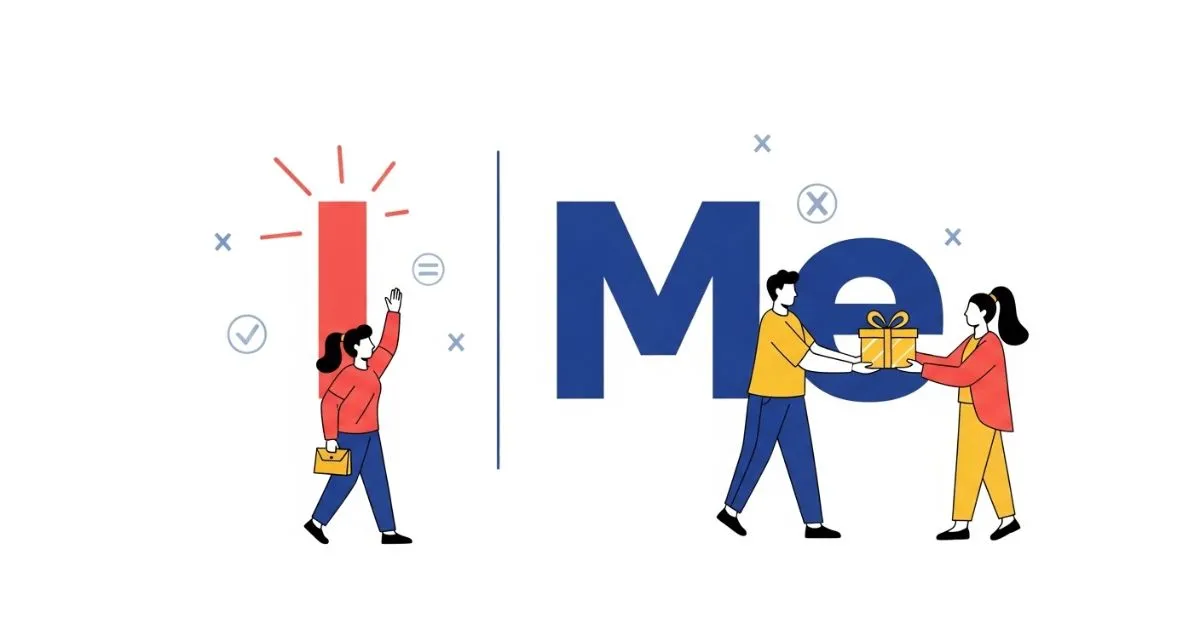
I → ✅ Subject (does the action)
Me → ✅ Object (receives the action)
Examples:
✅ “I went to the store.”
✅ “She called me.”
❌ “Me went to the store.”
👉 Tip:
- I = doer
- Me = receiver
The Origin of I or Me
The words I and me come from Old English.
- I comes from ic, used as the subject of a sentence
- Me comes from mē, used as the object
Over time, English kept both forms to clearly show who is doing the action and who is receiving it. This helps sentences stay clear and easy to understand.
British English vs American English Spelling
This is not a US vs UK difference. Both follow the same grammar rules.
| Region | Usage | Example |
| American English | I / me | “I called her.” / “She called me.” |
| British English | I / me | “I saw him.” / “He saw me.” |
👉 Key Rule: The difference depends on sentence role, not location.
Which Spelling Should You Use?
Choose based on the role in the sentence:
- Use I → when you are doing the action
- Use me → when the action is done to you
Audience Tip:
- US → same rule
- UK / Commonwealth → same rule
- Global → same rule
👉 Focus on subject vs object, not region.
Common Mistakes with I or Me
1. Using “me” as a subject
❌ “Me and John went out.”
✅ “John and I went out.”
2. Using “I” as an object
❌ “She gave it to John and I.”
✅ “She gave it to John and me.”
3. Overcorrecting
People try to sound formal and use “I” everywhere
❌ “Between you and I”
✅ “Between you and me”
4. Not testing the sentence
👉 Remove the other person:
“John and I went” → “I went” ✅
“John and me went” → “Me went” ❌
I or Me in Everyday Examples
Emails:
“I will send the report.”
“Please contact me for details.”
Workplace:
“My manager asked me to help.”
“I completed the task.”
Social Media:
“Join me for this event!”
“I just finished this project!”
News:
“The president said, ‘I will act now.’”
“The decision affects me directly.”
Formal Writing:
“I believe this method works best.”
“The results surprised me.”
📊 I or Me – Google Trends & Usage Data
Both words are extremely common but used differently:
- I → Very high usage (subject sentences)
- Me → Very high usage (object sentences)
| Keyword | Popularity | Usage |
| I | Very High | Subject |
| me | Very High | Object |
SEO Tip: Use both correctly to improve clarity and professionalism.
Comparison Table
| Word | Status | Role | Example |
| I | ✅ Correct | Subject | “I am here.” |
| me | ✅ Correct | Object | “Call me later.” |
FAQs❓
1. When do I use “I”?
Use it when you are doing the action.
2. When do I use “me”?
Use it when the action is done to you.
3. Is “me and my friend” correct?
No, say “my friend and I” (as subject).
4. Is “between you and I” correct?
No, correct form is “between you and me.”
5. How can I check quickly?
Remove the other person and test the sentence.
6. Do US and UK use different rules?
No, both follow the same grammar rules.
7. Is this a grammar or spelling issue?
It’s a grammar rule based on sentence role.
Conclusion
Understanding the difference between i or me becomes easy once you focus on one simple rule: I is for the subject, and me is for the object. Even though both words refer to yourself, they play very different roles in a sentence.
The confusion usually happens when more than one person is involved, like “John and I” or “John and me.” Many people guess based on what sounds formal, but that often leads to mistakes. The better approach is to test the sentence by removing the other person. This small trick can instantly show you the correct choice.
The good news is that this rule is the same everywhere. If you’re writing in American English, British English, or for a global audience, the usage does not change.
By practicing this rule and checking your sentences, you can avoid one of the most common grammar mistakes. Over time, choosing between “I” and “me” will feel natural, and your writing will become clearer, more professional, and more confident.

“I’m Agatha Christie, the grammar expert behind Grammeriffy.com. I help readers master English with clear, reliable writing tips.”